This article was originally posted here >> https://techsabado.com/2026/08/22/burning-chrome-sorceress-brings-mythology-sexuality-and-heavy-metal-into-the-gallery/
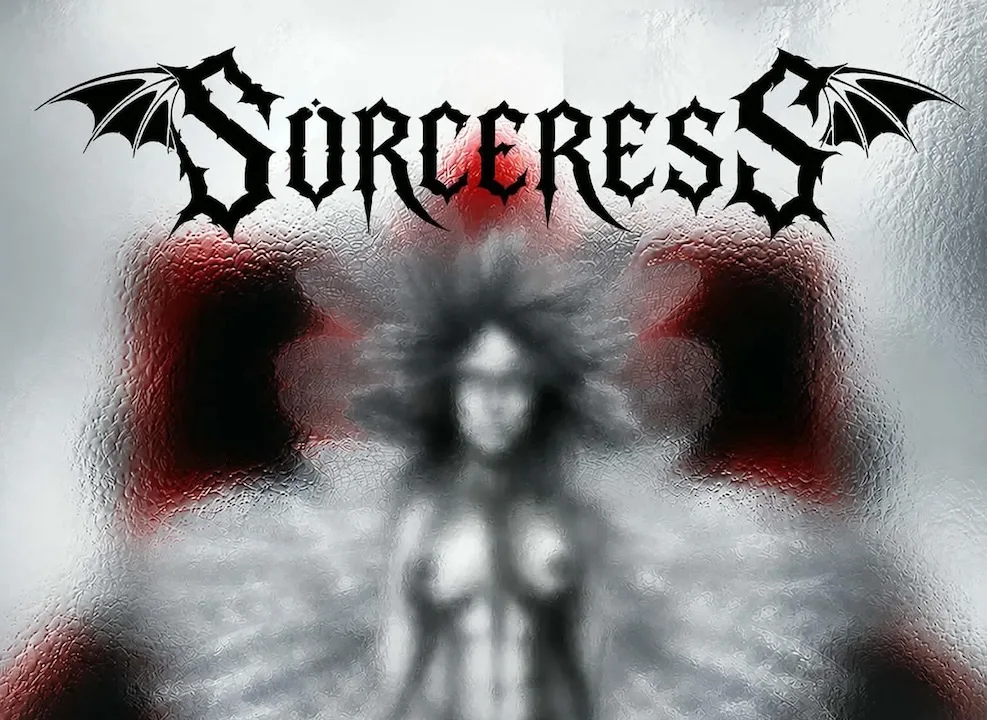
Katya Angara opened her second solo exhibition, “SORCERESS,” on Aug. 18 at The Crucible Gallery at SM Megamall, presenting drawings, paper works, assemblages and mixed-media pieces that move between the human body, animals, insects, feathers and other forms drawn from nature.
“SORCERESS” is on view through Aug. 30.
I wasn’t able to have an in-depth conversation with Katya about the works during the opening, so this is not meant to be a definitive interpretation of her practice. It is a reading of what I saw at the exhibition.
“SORCERESS” was described as a story of initiation, solitude and transformation, drawing, as stated in the exhibition description, from the writings of Carl Jung and Joseph Campbell. It presents the works as explorations of psychological and numinous realms, using myth and metaphor to examine existence, sexuality and the darker aspects of the self. The imagery makes those concerns fairly easy to recognize.
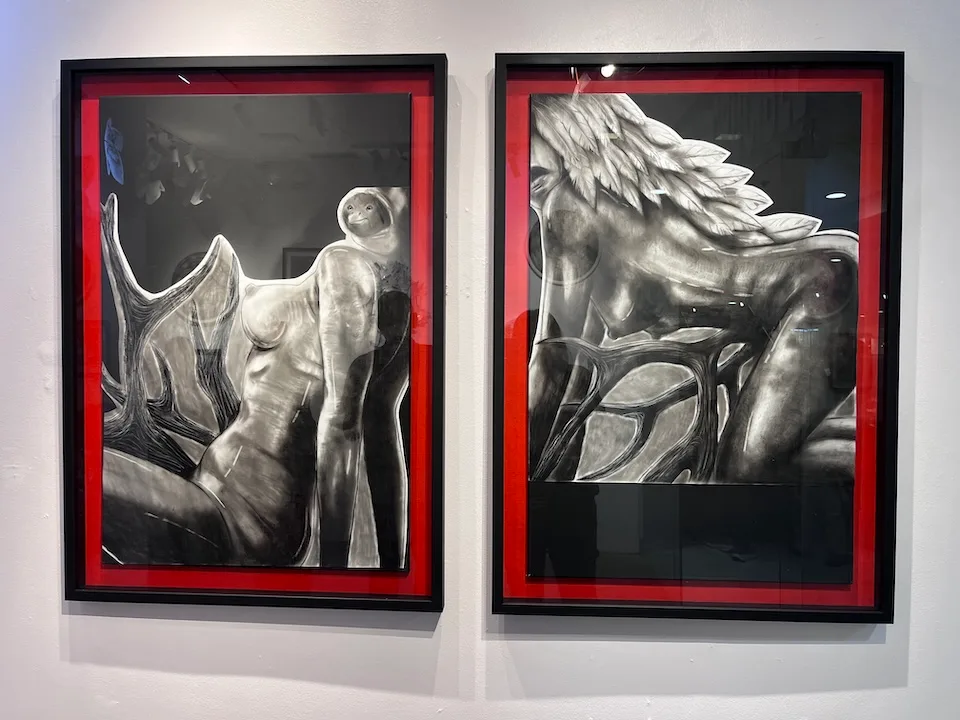
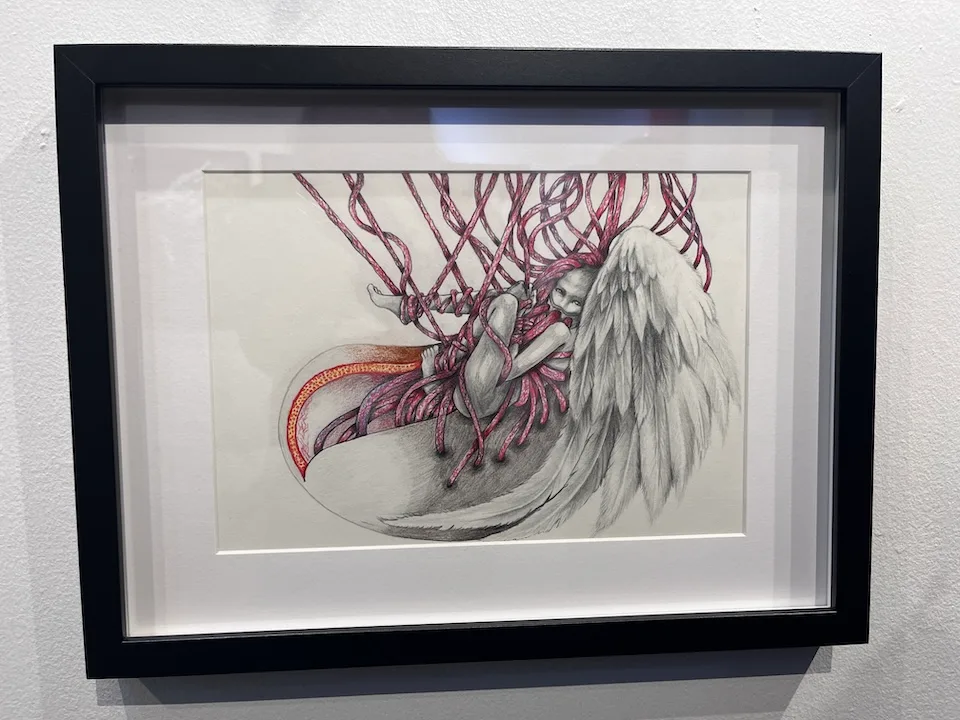
Katya’s female figures are rarely presented as conventional portraits or nudes. They are surrounded, interrupted or transformed by wings, feathers, insects, flowers, antlers and other forms from the natural world. In several pieces, the distinction between human and nonhuman becomes deliberately unclear. That recurring hybridity is one of the exhibition’s strongest characteristics.
The sorceress is not necessarily a single woman or character. She functions more like an archetype that takes different forms throughout the exhibition. The female body becomes a meeting point for animal, insect, plant and human characteristics, making transformation less a dramatic event than a continuing condition.
This continues what Katya has been doing in her art for years. Her practice has moved across drawing, paper art, black-and-white photography and mixed-media experimentation, with recurring interests in nature, sexuality, death, femininity and transformation. In “SORCERESS,” those interests appear to have been brought together into a more elaborate visual system.
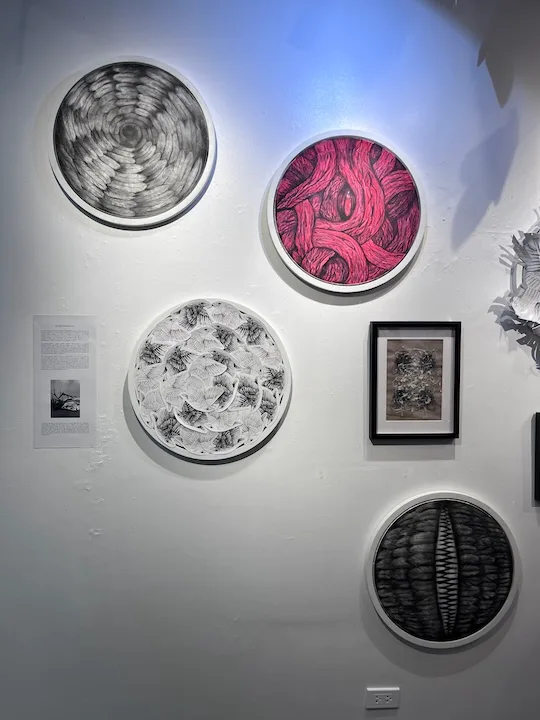
The drawings are particularly striking for their obsessive attention to detail. Feathers, wings, insects and other structures are built through the accumulation of small marks. From a distance, the images can appear delicate; up close, they reveal an intricate density.
There is a useful tension between that delicacy and the more disturbing elements of the imagery. Some pieces incorporate claws, antlers, exposed bodies, tangled forms and intense red shapes that can suggest blood, flesh, wounds or flowers. The result is often beautiful without being entirely comfortable.
Much of the exhibition is dominated by black and white, giving the drawings a stark, almost graphic quality. Red appears as an intrusion, introducing something more physical and corporeal. Depending on the piece, it can suggest blood, sexuality, flesh or biological matter.
The exhibition statement explicitly connects black, red and white with an alchemical process of life, death and rebirth. That interpretation is supported by the imagery, although the pieces do not require the viewer to settle on one literal meaning for the colors.
The circular pieces are another important element. Their repeated feathers and organic forms create compositions that can resemble nests, eyes, cells, flowers or vortices. Instead of directing the eye toward a conventional narrative, the format encourages it to move around the image and repeatedly return to its center. That works particularly well with the exhibition’s stated interest in cycles and Jungian circumambulation.
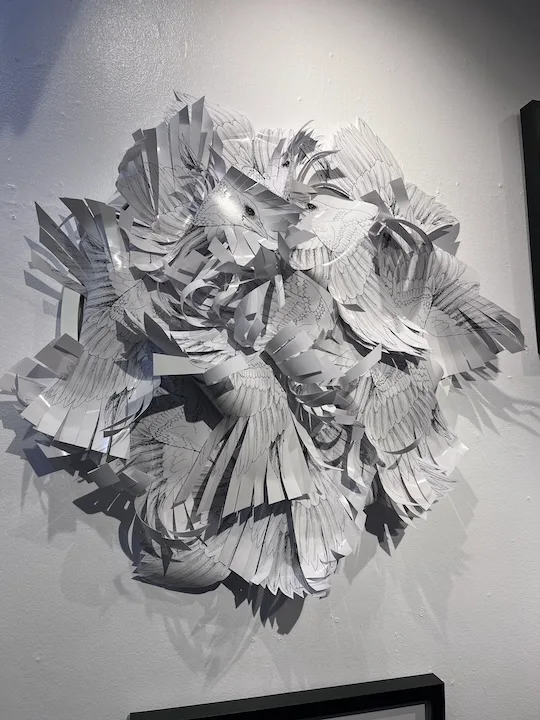
The paper constructions take these ideas beyond drawing. One of the larger pieces consists of layered paper birds and feather-like forms projecting from the wall. The individual elements retain their graphic character while becoming a physical installation. Because they extend from the surface, they also cast shadows. That physical shadow becomes part of the piece. I’m not actually sure if it was deliberate, but it’s there.
Given the exhibition’s explicit interest in the shadow self, this is one of the places where the conceptual framework and material execution come together most effectively. The piece doesn’t merely depict a shadow; its construction produces one.
Katya’s use of paper also emphasizes the physical labor behind the imagery. At a time when elaborate fantasy images can be generated almost instantaneously with software, there is something distinctly analog about these pieces. The feathers have been drawn. The paper has been cut and assembled. Larger forms emerge through accumulation and repetition.
That does not make handmade work inherently superior to digital work, but here the labor contributes directly to the psychological quality of the images.
The visual language also brought back a specific cultural reference for me. During the opening, I remarked to Katya that some of the pieces reminded me of the old Heavy Metal magazine, particularly its combination of elaborate fantasy illustration, sexuality, grotesque anatomy and creatures somewhere between the beautiful and the disturbing.
Katya acknowledged the observation, and it turned out that she is actually into heavy metal, including Iron Maiden.
That exchange made the connection more interesting because the resemblance is not simply visual. Katya’s practice shares some of the older fantasy-art tradition’s willingness to place sexuality, mythology, monsters and elaborate illustration within the same imaginative space.
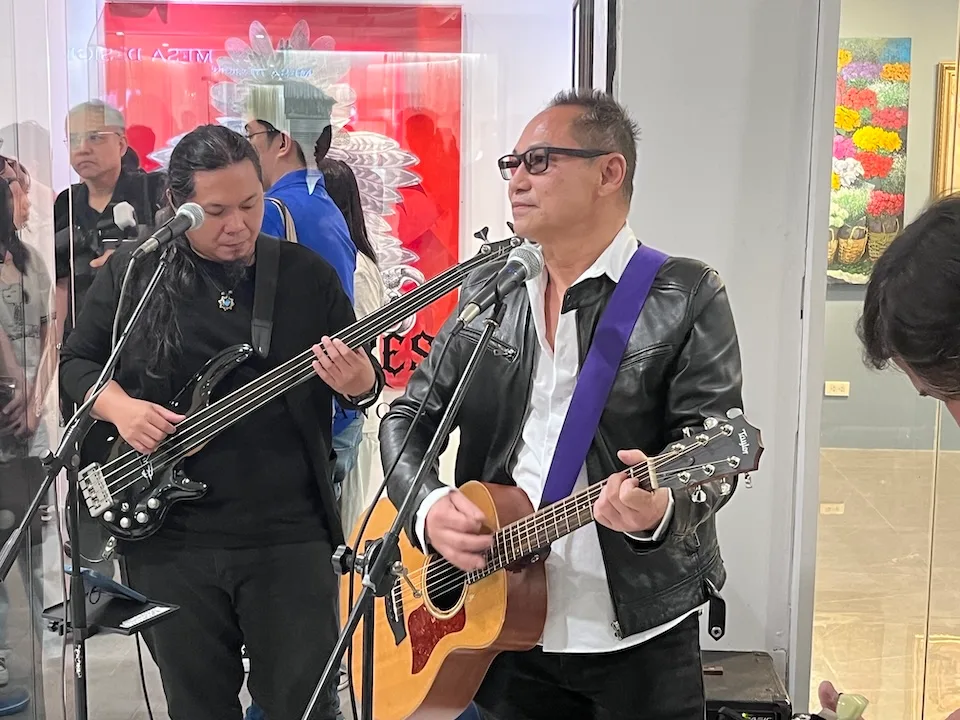
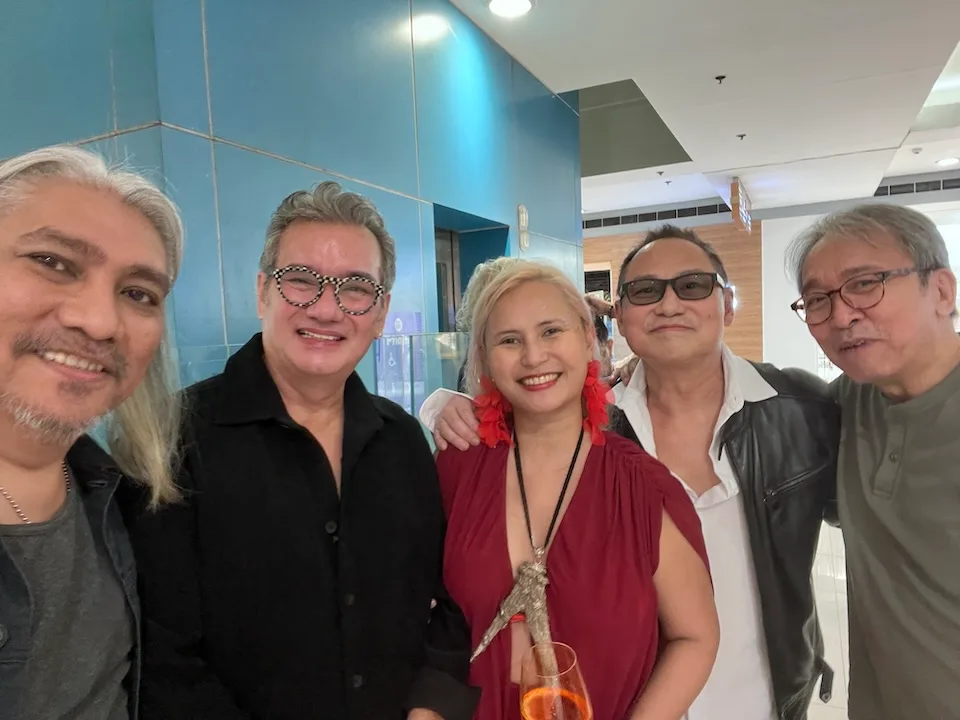
There was, appropriately enough, live rock music at the opening. Stephen Liu, lead of Rizal Underground and one of the veteran figures of Philippine rock, performed a number of rock classics during the evening. Stephen is also an old friend whom I have known since the mid-1980s, so his presence at an art opening brought together two parts of a cultural landscape that have long overlapped but are not always discussed together.
Buddy Trinidad was also there. Buddy is another friend from that older Philippine rock milieu and now a prominent pastry chef, although his history as a guitarist for pioneering punk band Betrayed remains an important part of his place in Philippine rock.
Sari Ortiga, owner of The Crucible Gallery, was of course present. Sari has become a good friend of mine through the local art circle, and as far as I’m concerned, The Crucible has been supporting the alternative scene ever since Ben Cab did the Pinoy Rockstar portraits in the mid-1990s.
I am less interested in taking every Jungian, Campbellian or alchemical reference literally than in looking at how those ideas manifest materially. A woman merging with an insect is visually strange before anyone explains the symbolism. A cluster of feathers forming a circular vortex already suggests movement and repetition. A paper bird projecting a shadow onto the wall creates a relationship between presence and absence. The strongest moments come when those relationships are allowed to operate on their own.
That is also where the Heavy Metal connection becomes useful. The older fantasy-art tradition understood that bodies, monsters, sexuality and mythology could coexist without having to be made respectable or rationalized. Katya similarly allows the erotic, grotesque, natural and supernatural to occupy the same space.
For me, that is the more interesting way to approach “SORCERESS”: not simply as an occult-themed exhibition, but as another stage in Katya’s continuing exploration of the body, nature, sexuality, identity and transformation.
The mythology provides the vocabulary, but the physical pieces make the argument. Their strongest moments come from the collision of delicate craftsmanship with imagery that is simultaneously sensual, biological and slightly unsettling.
In an increasingly automated visual culture, there is also something stubbornly analog about Katya’s process. The repetition, irregularities and physical construction remain visible, giving the pieces a character that cannot be separated from how they were made.
“SORCERESS” ultimately presents the body as unstable and porous, capable of becoming something else. Katya uses drawing, paper and mixed media to make that instability visible.
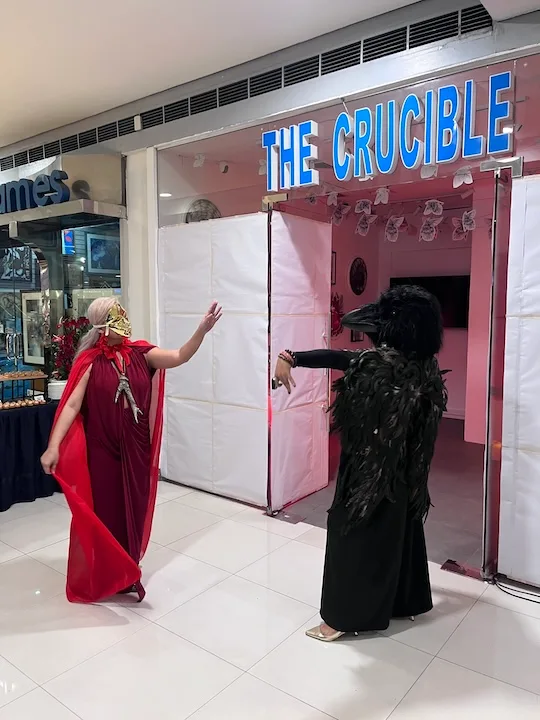
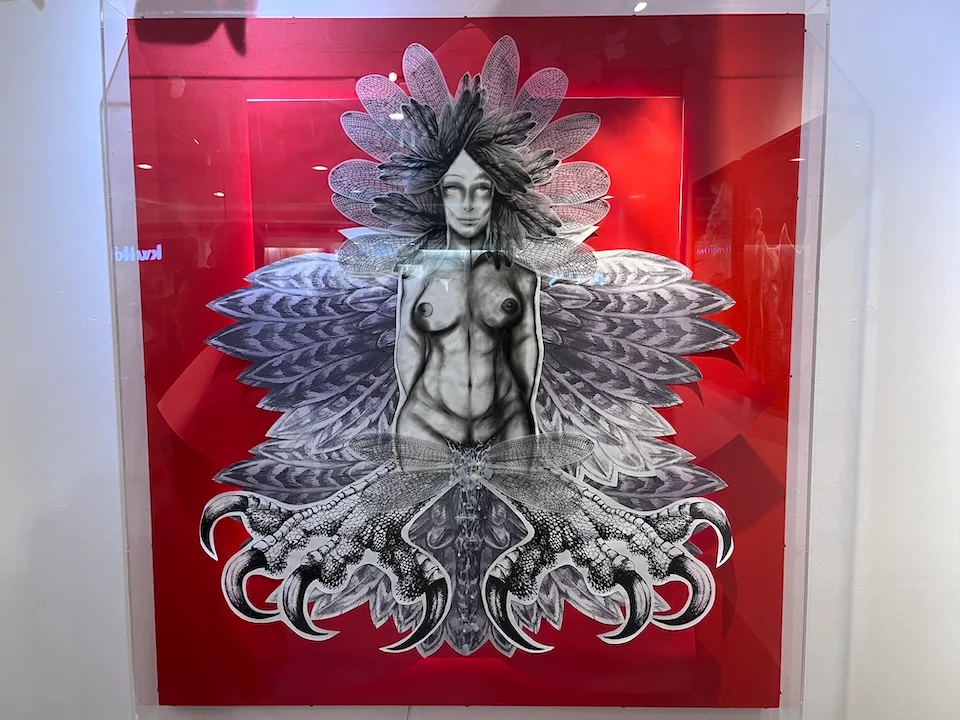
“SORCERESS” by Katya Angara is on view through Aug. 30, 2026, at The Crucible Gallery, Level 4, Building A, SM Megamall.
This article was originally posted here >> https://techsabado.com/2026/08/22/burning-chrome-sorceress-brings-mythology-sexuality-and-heavy-metal-into-the-gallery/


No comments:
Post a Comment