Thursday, January 22, 2026

TRANSMISSION | Industrial music: A generational history of noise, power, and control

Industrial music never began as a genre in the conventional sense. It emerged as a refusal, a deliberate collapse of the social contract between artist and audience, between sound and pleasure, between culture and comfort. Where rock music promised transcendence, industrial music documented containment. Where pop sought identification, industrial insisted on exposure. It was less interested in what music could express than in what sound could reveal about the systems people were already living inside.

The first generation of industrial music exists before the name itself, stretching from the postwar avant-garde into the early 1970s. This proto-industrial generation was defined by method rather than scene. The groundwork was laid by figures such as Pierre Schaeffer, who treated recorded sound as manipulable matter, and John Cage, who dismantled intention, authorship and the hierarchy of musical sound. The idea that noise could be neutral, structural or revelatory rather than expressive was further brutalized when Lou Reed released Metal Machine Music, a record that functioned less as provocation than as refusal. This first generation established the industrial premise: sound as evidence, repetition as condition and discomfort as a legitimate form of truth.

The second generation, beginning in the mid-1970s, is where industrial music became self-aware and named. The formation of Industrial Records in 1976 gave the movement both a banner and a threat. Its central project, Throbbing Gristle, did not merely make abrasive music; it collapsed boundaries between performance art, documentation, taboo and psychological warfare. Around it emerged a constellation of groups that treated sound as social analysis rather than entertainment. Cabaret Voltaire dissected surveillance, media feedback and information overload through tape loops and electronics. SPK turned psychiatry, medicine and institutional violence into sonic material. Test Dept transformed labor politics into metal percussion and strike-era ritual. Einstürzende Neubauten collapsed architecture into sound, using construction tools to literalize the violence of the built environment. This generation defined industrial music as antagonistic culture rather than subculture, aimed less at community building than at tearing holes in the surface of everyday life.

The third generation, emerging in the early 1980s, expanded industrial music outward into ideology, symbolism and belief systems. The sound diversified, but the method remained forensic. Laibach used the aesthetics of totalitarianism not as parody but as mirror, forcing audiences to confront their own attraction to power and spectacle. Coil redirected industrial toward mysticism, sexuality and occult systems, treating sound as ritual rather than shock. Clock DVA explored cybernetics and control theory, while Nocturnal Emissions fixated on paranoia, propaganda and social collapse. Running parallel to this trajectory was Psychic TV, where ex-Throbbing Gristle Genesis P-Orridge extended industrial music into video, broadcast media, ritual and networked identity, treating culture itself as a manipulable signal rather than a fixed form. In this generation, industrial music stopped merely reflecting factories and institutions and began interrogating ideology itself, exposing how belief, authority and identity are manufactured.

The fourth generation arrived in the mid-to-late 1980s with the rise of Electronic Body Music, where industrial logic was translated into disciplined, repetitive rhythm. This was not a softening so much as a mechanization of the body. Front 242, Nitzer Ebb and DAF reduced language to commands and slogans, turning dance into a simulation of obedience. Movement was permitted, but only under constraint. The persistent misunderstanding of EBM as celebratory rather than critical became one of industrial music’s enduring problems, as aesthetics of control are easily consumed without analysis.

Throbbing Gristle

The fifth generation, centered in North America in the late 1980s and early 1990s, fused industrial sound with emerging anxieties around digital technology, biotechnology and late Cold War paranoia. Skinny Puppy weaponized sampling and horror imagery to expose animal testing, psychological abuse and systemic cruelty. Front Line Assembly mapped cyberwarfare and technological dystopia, while Ministry translated industrial antagonism into political rage and amplified aggression. This generation brought industrial music into wider circulation without fully neutralizing its hostility.

The sixth generation, emerging in the 1990s, marked industrial music’s partial absorption into mainstream culture through industrial metal and alternative rock. Bands such as Nine Inch Nails and Rammstein retained sonic markers of industrial while packaging them for mass consumption. The sound survived, but its structural opposition weakened. Industrial became an aesthetic, a texture, a mood rather than a method of critique. This shift was not a failure so much as an inevitability once the genre’s surface elements proved marketable.

The seventh and ongoing generation is post-industrial by necessity. Industrial music no longer consolidates around a single sound or scene. It fragments into noise, power electronics, dark ambient, experimental techno and sound art. The industrial impulse persists wherever artists interrogate surveillance, labor, infrastructure and control, even when the term itself is abandoned. In an era in which platforms replace factories and algorithms replace foremen, the industrial condition has not disappeared; it has become frictionless.

Beyond the Anglo-European core, industrial music was decisively shaped by parallel developments in German 70s krautrock and current Japanese noise (Japanoise). In West Germany, krautrock’s confrontation with postwar identity, technology and repetition provided a crucial bridge between avant-garde experimentation and industrial logic. Groups such as Can, Neu!, Faust and Kraftwerk normalized motorik rhythm, machine aesthetics and the idea of music as system rather than expression—principles industrial music would later radicalize. In Japan, noise emerged not as genre refinement but as total saturation. Artists such as Merzbow, Hijokaidan and Incapacitants pushed sound past critique into excess, volume and physical endurance. Japanoise demonstrated that industrial music’s endpoint was not structure but collapse: when systems become too dense to interpret, noise itself becomes the only honest form of documentation. Together, krautrock’s disciplined repetition and Japanoise’s total overload expanded industrial music from a European provocation into a global method for confronting the machinery of modernity.

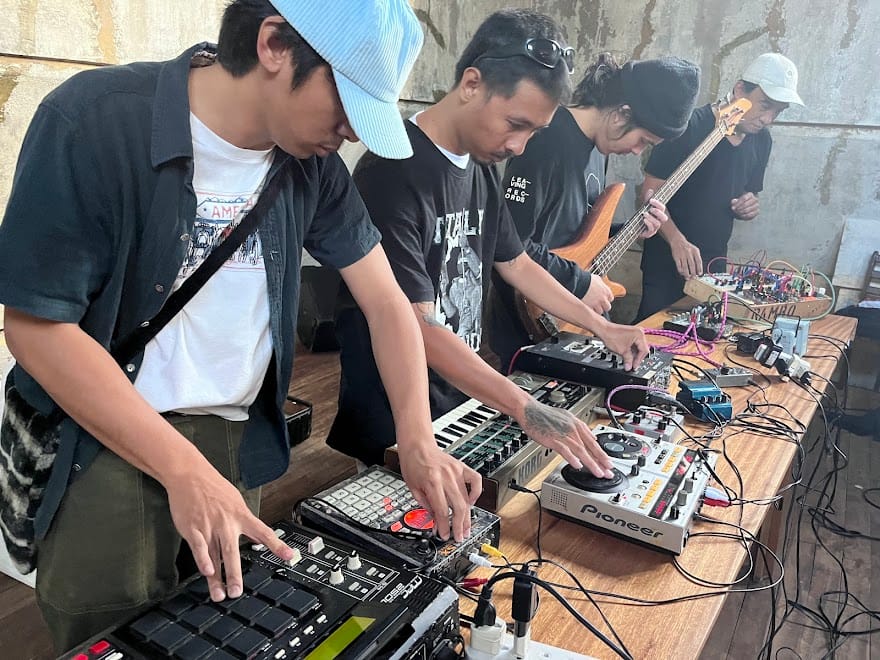
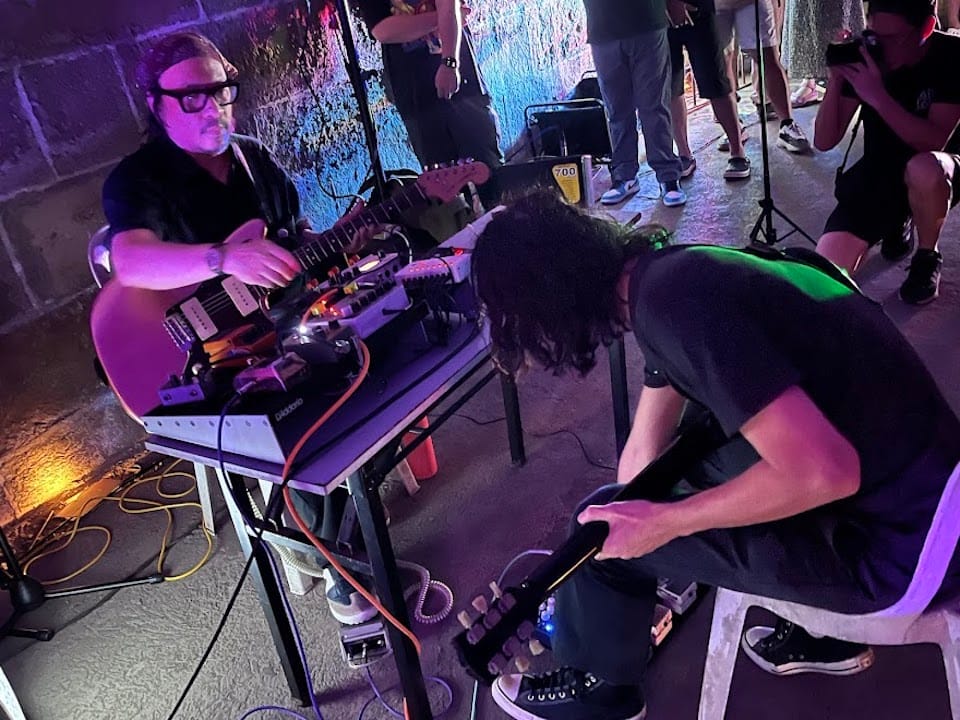
In the Philippines, industrial music never consolidated into a formal movement, but its logic has surfaced repeatedly at the margins of post-punk, noise, and sound art. The country’s experience of authoritarian spectacle, labor extraction, disaster-prone infrastructure, and nonstop media saturation produced conditions that align closely with industrial music’s original concerns, even when expressed through different sonic forms. In the early 1980s, Wuds absorbed industrial restraint through post-punk minimalism, translating alienation into tension rather than overt noise. By the 1990s and 2000s, experimental and noise practices engaged the industrial method more directly while often rejecting the label itself. Projects such as Elemento (ni Lirio Salavador), and Children of Cathode Rayor even Tengal, approached sound as system and material, working with electronics, feedback, field recordings, and process-driven composition rather than song form. Even groups operating closer to rock structures, such as Lourd de Veyra's Kapitan Kulam, reflect industrial thinking in their use of repetition, ritual, and sonic pressure. In the Philippine context, industrial music appears less as a recognizable genre than as an operating principle: sound as documentation of environment, power, and psychological strain. Where infrastructure is unstable and authority is theatrical, the industrial impulse persists not as Western imitation but as an adaptive response to present conditions.

Industrial music still matters because it refuses nostalgia and denies escape. It does not offer identity, catharsis or comfort. It listens to the present as it is experienced by bodies inside systems and reproduces that experience without apology. Industrial music is not about rebellion in the romantic sense. It is about documentation, about holding sound up to power and letting the noise speak for itself.  >>autoceremony]


Tuesday, January 20, 2026

TRANSMISSION | Why British anarcho-punk still refuses to die

British anarcho-punk was never designed to endure as a genre, yet it persists because it was never really a genre to begin with. It functioned as a refusal mechanism, a way of exposing how power organizes everyday life and how easily dissent is neutralized once it becomes fashionable. What emerged in late-1970s and early-1980s Britain was not simply loud, political punk, but a tightly interlinked system of ethics, sound, production, and behavior that refused separation between art and responsibility. The fact that it still feels contemporary is less a testament to its innovation than to the stubborn durability of the conditions it opposed.

At the center of this gravity was Crass, not as leaders but as catalysts. Crass rejected hierarchy so completely that even the idea of frontmen, success, or musical prestige became suspect. Their records functioned as dossiers rather than entertainment, combining abrasive sound, spoken word, collage, essays, and confrontation. They treated anarchism not as an aesthetic posture but as a daily discipline: anti-war, anti-capitalist, anti-nationalist, anti-consumerist, and deeply hostile to the spectacle logic of both the state and the music industry. Punk, in their hands, was stripped of glamour and forced to confront its own contradictions.

Around this core formed a network rather than a scene. Conflict pushed anarcho-punk into a more militant register, channeling anger into speed, confrontation, and direct action politics. Their alignment with animal liberation and street-level resistance made clear that anarcho-punk was not merely rhetorical. It demanded consequence. Subhumans took a different approach, emphasizing clarity and communication. Their songs dissected state power, education, social conditioning, and obedience in language that was accessible without being diluted, making anarchist critique intelligible to listeners who might otherwise encounter it only as caricature.

Bands like Flux of Pink Indians sharpened the critique further by attacking liberal reformism and consumer culture with uncomfortable precision, exposing how incremental change often stabilizes the very systems it claims to challenge. Poison Girls, led by Vi Subversa, expanded anarcho-punk’s scope by centering feminism, sexuality, family structures, and emotional labor, forcing the movement to confront domination at the intimate level rather than outsourcing oppression solely to the state. Zounds demonstrated that anarcho-punk could be reflective and melodic without losing political force, writing songs that examined war, complicity, and everyday life with a quiet but persistent urgency.

As the movement evolved, its darker edge became unavoidable. Amebix and Antisect dragged anarcho-punk toward heavier, more apocalyptic terrain, giving rise to crust punk as a sonic and ideological extension. Their music sounded less like protest and more like prognosis, anticipating ecological collapse, social breakdown, and the exhaustion of reform long before such ideas became mainstream talking points. Alongside them, bands such as Rudimentary Peni, Icons of Filth, The Mob, and Omega Tribe reinforced anarcho-punk as a distributed network of ideas rather than a centralized movement, each articulating resistance through different emotional registers: paranoia, introspection, rage, or restraint.

Orbiting this core were bands that were not strictly anarcho-punk but ideologically adjacent and culturally entangled. UK Decay captured the psychological residue of authoritarianism through post-punk atmosphere and dread, while G.B.H. and U.K. Subs translated working-class anger and anti-authoritarian sentiment into blunt, accessible forms that widened punk’s audience without necessarily sharing anarcho-punk’s full ideological rigor. Their presence mattered because anarcho-punk was never sealed off; it existed in friction with the broader punk ecosystem.

What unified these bands was not sound but alignment. DIY was not treated as nostalgia or style but as counter-infrastructure. Independent labels, zines, squat gigs, benefit shows, and informal distribution networks were practical attempts to withdraw creativity and labor from systems built on extraction and control. Lyrics read like warnings rather than slogans. Artwork functioned as evidence rather than branding. Discomfort was intentional, because comfort implied accommodation.

Today, anarcho-punk circulates in collapsed timelines. It appears on streaming platforms alongside contemporary hardcore, noise, industrial, and politically explicit hip-hop. It is reissued on vinyl not as collectible fetish but as documentation. Lyric sheets and artwork matter again because context matters again. Younger listeners do not approach it as retro rebellion but as unfinished theory set to sound.

British anarcho-punk refuses to die because it never promised resolution. It offered diagnosis. Concentrated power, commodified dissent, permanent war, and managed consent were never temporary failures. They were structural features. In a present where rebellion is monetized, outrage is optimized, and resistance is flattened into content, anarcho-punk’s refusal to be efficient, likable, or profitable remains its most radical quality.

It does not ask to be revived.
It does not ask to be forgiven.

It remains relevant because it still names the machinery, and because the machinery is still running. >>autoceremony]


Sunday, January 18, 2026

TRANSMISSION | Yacht rock says a lot about rock’s midlife crisis

Yacht rock did not exist when the music was made. It exists now because platforms needed a word for comfort. The label is not descriptive so much as managerial—a way to group sounds that are smooth, reliable, and incapable of causing friction in public or private space. In that sense, yacht rock is not a rediscovery. It is a continuation.

It is corporate rock, updated for the streaming age.

In the 1980s, corporate rock was blunt about its function. It lived on FM radio, soundtracked office towers, and mirrored the values of stability, scale, and upward mobility. Its production was clean, its musicianship professional, its emotional range carefully bounded. It did not challenge power. It synchronized with it. Yacht rock inherits this logic almost intact, but now it arrives disguised as irony, nostalgia, and “good vibes.”

The rebrand is softer, but the structure is the same.

Today, this music circulates less through radio than through playlists—most prominently on Spotify—where yacht rock thrives as algorithmic wallpaper. It appears in playlists built around leisure, productivity, and male self-mythology: driving, working out, on the beach, “classic cool,” or—if you are well-off enough— actually yachting. These lists are rarely overtly ideological, which is precisely the point. They flatten history into mood. They remove conflict. They turn music into a solvent.

This is where the banality becomes unmistakable.

Streaming does not care about context. It cares about flow. Yacht rock excels at flow. The tracks are mid-tempo, harmonically pleasing, rhythmically stable. They do not interrupt. They do not demand attention. They are as safe as elevator muzak—engineered to fill silence without ever questioning why the silence is there.

The effect is reassuring, even narcotic. It allows the listener—often a corporate-type, affluent, middle-aged man—to feel tasteful without being challenged. Excess without guilt. Nostalgia without reckoning.

The men have changed uniforms. The power suit has become the white sport shirt. The leather loafer has become Crocs—or, for many Pinoys, a pair of Onitsuka Tiger sneakers. The attitude remains untouched.

What makes this particularly cynical is how many artists get flattened in the process. Steely Dan are reduced to “smooth,” despite writing some of the most caustic, morally acidic songs in rock history. Toto are framed as soft rock despite being elite studio musicians with deep jazz and progressive roots. The Doobie Brothers’ Michael McDonald era becomes shorthand for slickness, ignoring its debt to soul discipline. Hall & Oates are absorbed into the category despite their grounding in rhythm-and-blues traditions. Christopher Cross is dismissed as excess incarnate, punished less for the music than for sincerity.

These artists were not making lifestyle playlists. They were responding to industrial pressures: the rise of studio technology, the collapse of earlier rock mythologies, and the demand for precision over chaos. That tension has been erased by streaming logic, which does not distinguish between intention and utility. Everything becomes content.

Outside the US of A, the effect is arguably more corrosive. This sound circulated globally as a signal of modernity—English-language rock polished enough to imply access, success, and proximity to Western capital. Streaming has amplified that legacy, circulating the same narrow aesthetic endlessly, detached from geography, politics, or history. What once marked aspiration now marks comfort.

This is why yacht rock is best understood not as a genre but as a condition.

Corporate rock once represented rock’s compromise with power. Yacht rock represents rock’s surrender to convenience. The rebellion is gone. The argument is gone. What remains is music optimized to disappear into the background while sounding expensive.

It floats well. It streams well. It offends no one.

And in a system designed to reward frictionless consumption, that safety is not a side effect. It is the product.  >>autoceremony]


Saturday, January 17, 2026

BURNING CHROME | Resonances and revolutions — from noise to art (Part 1)

by Jing Garcia -- because the mind is a terrible thing to taste.

Originally posted on: techsabado.com/2025/10/04/burning-chrome-resonances-and-revolutions-from-noise-to-art-part-1/

The question of what makes music has always been fraught, but the 20th century shook it to its core. When John Cage staged his infamous 4'33 in 1952, turning silence into performance, he wasn’t just provoking a scandal. He was exposing an idea: that listening itself could be art. This was no accident of history. The groundwork had been laid in Europe by Pierre Schaeffer’s musique concrète, which spliced together recorded noises, and in America by Cage, Alvin Lucier and La Monte Young, who tested the edges of sound, duration and perception.

By the 1970s, Max Neuhaus and others were setting up sound installations in public spaces, making the city itself the instrument. The term sound art formally entered circulation with the 1979 exhibition Sound Art at the Museum of Modern Art in New York, curated by Barbara London. It was a moment that confirmed what had begun as a radical experiment in music was now crossing the borders of visual art, architecture and performance. Sound had left the concert hall.

What makes sound art different from experimental music? Scholars often point to context. Experimental music still clings, however loosely, to composition and performance. Sound art takes sound as its raw material, often stripped of melody or rhythm, and situates it in space—an installation, a gallery, a street corner. But the two have never been easily separated. They bleed into one another, influencing, cross-pollinating and reshaping how we understand listening.

That porousness made its way to Asia too. Japan birthed Japanoise, with artists like Merzbow, Keiji Haino and Hijokaidan unleashing sonic extremes that refused melody altogether. The Onkyō movement, led by Sachiko M and Toshimaru Nakamura, took the opposite tack, reducing music to near silence, glitch and texture. Taiwan’s Wang Fujui developed noise art and installations that pushed electronics into sculptural forms. Across Asia, sound practices—whether raucous or quiet—began to slip into experimental music festivals, art biennales and underground scenes.

The Philippines, though late to institutional recognition, had already been developing its own experiments. Lirio Salvador stands as a pivotal figure. With his band Elemento, Salvador constructed homemade instruments from chrome, bicycle parts, and industrial scrap. His sculptural instruments, which he called Sandata, were not just tools for performance; they were artworks themselves. His practice blurred sound art and visual art long before local institutions were ready to accept it. Salvador, who is still recovering from a 2012 accident that left him in a vegetative state, has a living legacy that resonates in every Philippine sound practice today.

Around the same time, collectives began to form. One of the earliest was Children of Cathode Ray, established in 1989, a group that treated analog video synths, obsolete television monitors, and found electronics as material for live sound and image performances. This audiovisual assault anticipated today’s immersive media installations, but at the time it was raw experimentation, improvised in warehouses and art spaces. From that same lineage emerged autoceremony (2004), a solo project that dove even deeper into the textures of noise and drone, combining a performance art sensibility with a devotion to the hypnotic possibilities of repetition and static.

Documentation in those days was scarce. The local mainstream music press barely glanced at these developments. What existed were small zines, community word of mouth, and eventually personal blogs. Among them were early 2000s Blogspot posts by me, a practicing journalist and reclusive sound artist, who chronicled performances, global trends in sound art, and local experiments in Manila. These writings—now digital artifacts themselves—were among the first online attempts to map the country’s sound art landscape.

Parallel to these underground movements were academic initiatives. At the University of the Philippines, curator and professor Dayang Yraola, who was at that time with the UP Center for Ethnomusicology, began integrating sound into exhibitions and research. Her projects, such as Sonic Manila Research and Listen to My Music, pulled field recordings, experimental compositions and installations into institutional contexts. Dr. Yraola’s curatorial work not only documented sound practice but also legitimized it, giving it visibility in museums and festivals at a time when sound art was still an alien phrase to most Filipinos.

By the mid-2000s, networks of artists and curators started connecting Philippine sound practitioners with the wider ASEAN scene. Indonesia had its own thriving noise collectives, Singapore was beginning to host interdisciplinary art festivals, and Japan’s influence on experimental practice was undeniable. This was fertile ground for collaboration. When the Goethe-Institut launched Nusasonic in partnership with regional artists, the Philippines was right there in the mix, bridging experimental scenes across borders.

This cross-regional fertilization set the stage for what we now recognize as Southeast Asia’s experimental sound culture—a hybrid space where tradition, politics, technology and noise converge. And within this constellation, the Philippines has staked its own claim, its artists as restless as their global peers, its history as fraught but as fertile as any.

----------

END OF PART 1

Originally posted on: techsabado.com/2025/10/04/burning-chrome-resonances-and-revolutions-from-noise-to-art-part-1/

Friday, January 16, 2026

TRANSMISSION | Social Media: The feed that eats the mind

There is a moment, somewhere between the third scroll and the fifth notification, when thinking quietly steps aside. Not because the mind has failed, but because the environment has changed. The feed does not invite reflection. It invites reaction. And over time, reaction becomes habit.

Social media did not arrive as a cultural weapon. It arrived as convenience—connection without effort, information without waiting. But convenience has a politics, and scale has consequences. A growing body of research shows that the systems governing today’s platforms systematically favor speed, emotion and repetition over verification, context and doubt.

Cognitive psychology has long distinguished between fast, intuitive thinking and slow, deliberative reasoning. Research synthesized in Daniel Kahneman’s Thinking, Fast and Slow has been replicated across disciplines: fast cognition is efficient but error-prone; slow cognition is accurate but demanding. Social media architectures bias relentlessly toward the former. Endless feeds, autoplay video and engagement metrics reward immediacy. Pausing to verify is friction. Friction reduces engagement.

A landmark study by researchers at MIT examined the spread of news on Twitter (now called X) and found that false information traveled faster, farther and more broadly than factual reporting. The effect was strongest when content provoked moral outrage or surprise. Truth was not losing because it was less available; it was losing because it was less competitive in an attention economy.

That finding reframes the problem. Misinformation is not an accident of social media. It is structurally advantaged by design.

Attention research deepens the picture. Studies from Stanford University and the University of California system show that constant task-switching—notifications, short-form video, fragmented reading—impairs working memory and reduces the brain’s capacity to evaluate evidence over time. This is not a question of intelligence. It is cognitive load. When stimuli pile up, the mind defaults to shortcuts: heuristics, stereotypes and emotional cues. Critical thinking doesn’t vanish. It gets crowded out.

The most uncomfortable evidence comes from inside the platforms themselves. Internal research disclosed by whistleblower Frances Haugen in 2021 revealed that Facebook repeatedly identified how its algorithms amplified divisive and misleading content, including political disinformation and material harmful to adolescents. The harm was documented. The trade-offs were known. Engagement remained the priority.

When profit and cognition collide, cognition loses.

Disinformation studies add another layer. Research by the Oxford Internet Institute has documented organized political manipulation campaigns on social media in dozens of countries, including the Philippines. These operations rely on coordinated networks, emotional narratives and algorithmic amplification. They are not spontaneous misunderstandings. They are engineered influence, scaled cheaply and deployed strategically.

Deepfakes push the crisis further. Work from University College London and U.S. defense-funded research programs shows that synthetic audio and video are approaching a point where human detection is unreliable without forensic tools. Once visual evidence can no longer be trusted, denial becomes effortless. Real abuses can be dismissed as fabricated. Fabrications can be weaponized as truth. The burden of proof shifts, always toward the vulnerable.

This marks a historical rupture. Modern societies were built on shared reference points—documents, recordings and witnesses. When those dissolve, trust becomes tribal rather than empirical. People stop asking what is true and start asking who benefits.

Platforms respond with moderation pledges, transparency reports and fact-checking partnerships. These measures matter, but they remain constrained by the same underlying incentive: engagement drives revenue. Emotional volatility drives engagement. Stability does not.

This is why critical thinking feels harder now. Not because people have become incapable, but because the environment is hostile to reflection. A system that punishes hesitation trains users to abandon it. A culture optimized for virality treats doubt as weakness.

In the Philippines, where journalism already competes with economic precarity, political pressure and platform dependency, the cost is magnified. Social media is not just a communication layer; it has become the default public square, newsroom and archive. When that square is engineered for amplification rather than verification, democracy inherits the distortion.

There was never a golden age of perfect rationality. But there were slower rhythms. Friction existed. Editors existed. Delay existed. Those pauses—imperfect, human, sometimes frustrating—were where judgment formed.

The feed removes delay. And in doing so, it removes the pause where thinking happens.

What is being eroded is not intelligence but patience. Not reason itself, but the conditions that allow it to surface. A society trained to react cannot deliberate. A public taught to scroll cannot remember. And a culture that mistakes engagement for understanding slowly forgets how to tell the difference.

The feed keeps moving. That is its triumph—and also its quiet, accumulating cost.  >>autoceremony]


Tuesday, January 13, 2026

TRANSMISSION | Waking up somewhere between Orwell and Huxley

You wake up, reach for your phone, and before your feet touch the floor, the system has already greeted you. Notifications, feeds, alerts, outrage, comedy, war, shopping. You scroll. You react. You comply. Not because anyone forces you to — but because it feels easier than not doing it.

You ask yourself, not for the first time: Is this Orwell? Or is this Huxley?

The lazy answer is to say it’s 1984 — because surveillance is real, because power lies, because truth feels negotiable. The other lazy answer is to say it’s Brave New World — because you’re drowning in content, pleasure, convenience, and synthetic calm.

But when you’re honest with yourself, neither quite fits. And that’s the paradox we live in.

In George Orwell’s 1984, the state watches you with omnipresent screens — telescreens — searing obedience into society through fear and punishment. You are visible, and you know it.

But today’s watchers are not Big Brother with a telescreen. They are faceless platforms, corporations built not on ideology but on an economic logic that monetizes you. Harvard scholar Shoshana Zuboff calls this surveillance capitalism — a regime where personal human experience is captured as raw behavioral data and turned into predictions that can be bought and sold.

The goal isn’t just to sell you ads. It’s to understand, anticipate, and influence what you do next, nudging you toward behaviors that maximize profit for platform owners. This is not state coercion; this is corporate behavioral shaping.

Zuboff warns that these practices erode autonomy and even democracy, because they rob individuals of what she calls the “right to the future tense” — the ability to envision one’s own trajectory and act freely toward it.

This isn’t chill surveillance. It’s instrumentarian power — a form of control rooted in markets, algorithms, and incentives rather than ideology and force.

If Orwell feared overt domination through fear, our present looks more like a quiet, ceaseless study of human behavior.

Every click, every swipe, every pause on a feed becomes part of your data shadow — the digital trace of your life that organizations collect, analyze, and use to model and predict everything from your political leanings to consumer desires.

The attention economy doesn’t need to frighten you into compliance. It conditions you through subtle cues and rewards. Algorithms are designed to exploit cognitive vulnerabilities and draw you deeper into cycles of engagement, weakening your capacity for sustained attention and critical judgment.

You aren’t forced to watch. You choose to watch — because the design of these systems makes disengagement feel like deprivation.

Aldus Huxley’s Brave New World feared a future where control comes not from brutality but from pleasure, distraction, and engineered contentment. In that world, citizens do not resist because they are too entertained to care.

Today, social media, video platforms, and recommendation engines compete not for truth but for attention — a scarce, monetizable resource. The more attention you give, the more your behavior can be predicted and, ultimately, guided.

You’re not denied information; you’re drowned in information. Genuine complexity is replaced with emotion-driven fragments: outrage, affirmation, spectacle -- often delivered through emojis and/or memes. The danger isn’t censorship — it’s that nobody wants to read anymore.

This is no cruel dystopia with banned books. Instead, it’s a quiet erasure of depth, replaced with dopamine hits and habitual scrolling.

The scariest part is that there isn’t a single, visible tyrant. There is no Ministry of Truth in clear view. Instead, power is layered, decentralized -- sort of, 'little brothers' rather than just a big one -- and obscured by convenience.

The little brothers -- the big tech behind those platforms we all love using -- collect behavioral data one click at a time. Algorithms decide what you see one prediction at a time. Platforms optimize for engagement, not truth. Politics becomes another content category to gamify.

In Orwell’s world, you would know you are being watched. In Huxley’s world, you would be too intoxicated to care.

What we have now is both, but not in the stark, dystopian binary imagined by either author. It is superficial freedom paired with deep informational and cognitive capture.

This is not tyranny by decree. It is enslavement by design.

Orwell feared a world where truth would be forbidden.
Huxley feared a world where truth would be irrelevant.

Today, the greater threat isn’t a leader with a megaphone. It’s a society that stops listening.

Your freedom is intact on paper. Your autonomy is eroded in practice.

This isn’t 1984.
This isn’t Brave New World.
This is something subtler — and arguably far more cruelly insidious: a digital condition where freedom is offered as a product, but agency is quietly extracted as data.

The most dangerous moment isn’t when they take your freedom away.
It’s when you stop noticing you ever had it.  >>autoceremony]


Saturday, January 10, 2026

BURNING CHROME | 3G: The network that connected us before the stream

by Jing Garcia -- because the mind is a terrible thing to taste.

Originally posted on: techsabado.com/2025/09/27/burning-chrome-3g-the-network-that-connected-us-before-the-stream/

The slow death of 3G is not just a technical story about telecom networks being retired. It is also about how we once imagined the internet in our pockets, how we built a society around that idea, and how we are now watching it quietly disappear into the digital graveyard.

The Philippines is among the countries preparing for the end of third-generation mobile technology. By 2026, if not sooner, the last signals of 3G will vanish from the airwaves, with Smart Communications and Globe Telecom switching off what remains of their networks. The Department of Information and Communications Technology (DICT) confirmed this in a September 2025 announcement carried by ABS-CBN News, saying: “We expect the phase-out of 3G networks by end of September, with complete decommissioning by 2026 to reallocate spectrum for more advanced mobile technologies.”

Yet before we bury 3G, it deserves a proper obituary. It was, after all, the network that made the modern smartphone possible, opened the doors to mobile apps, and carried millions of Filipinos through their first Facebook logins, video calls, and YouTube binges.

To appreciate 3G’s impact, you need to rewind to the late twentieth century when mobile communication was still a novelty. The first generation, or 1G, was pure analog. It gave us bulky handsets, dropped calls, and voice that often sounded like it was traveling through a tin can. Still, it was revolutionary: for the first time, you could talk while on the move, even if it cost a small fortune.

The second generation, 2G, arrived in the 1990s with digital transmission. It introduced text messaging, or SMS, and suddenly the Philippines became the “texting capital of the world.” Filipinos sent billions of messages a day, creating a culture that combined thrift, humor, and connectivity in 160 characters. Data did exist on 2G through GPRS and EDGE, but it was painfully slow.

Then came 3G, the third generation of wireless systems, standardized under the International Telecommunication Union’s IMT-2000 framework. According to ITU records and Wikipedia’s 3G history page, it was launched first in Japan by NTT DoCoMo in 2001 before spreading to Europe, the United States, and eventually Southeast Asia. In the Philippines, 3G licensing began in 2005, with telcos like Smart and Globe required to build out services by 2008, as reported by Phys.org. It was in those years that Filipinos first experienced mobile broadband.

Where 2G made texting addictive, 3G made the internet mobile. Suddenly you could browse web pages, download MP3s, or make a jittery video call without hunting for a desktop computer. At its peak, 3G speeds through HSPA and HSPA+ could reach several megabits per second—enough for early social media platforms and the rise of the smartphone era.

The age of smartphones

What made 3G special was not just raw speed but possibility. For the first time, carriers could market internet as a core service, not an add-on. Mobile apps became viable. Email on the go was no longer the exclusive privilege of a BlackBerry user with a corporate plan.

In the Philippines, 3G played a unique social role. With limited fixed broadband penetration outside the cities, 3G became the first true broadband experience for millions. Facebook’s rapid adoption among Filipinos in the late 2000s was powered less by DSL and more by 3G SIM cards inserted into Nokia handsets and early Androids. The telcos capitalized on this by offering “Facebook for free” bundles, a marketing strategy that expanded digital literacy while also locking people into walled gardens.

It was also a time when tech journalists noticed how the language around mobile phones began to shift. Devices were no longer just “cellphones” but “smartphones.” Applications were no longer pre-installed curiosities but downloadable ecosystems. Mobile internet stopped being a futuristic catchphrase and became part of everyday life.

But technology ages quickly. By the early 2010s, as video streaming surged and mobile apps became heavier, 3G’s limitations grew obvious. Pages loaded slowly, video calls broke apart, and latency made gaming nearly impossible. While HSPA+ offered a stopgap, it was already clear that a leap to fourth generation was necessary.

The pros of 3G were obvious: affordable handsets, global adoption, and enough bandwidth for early mobile internet. Its cons were equally glaring: high latency, relatively low efficiency, and an inability to keep up with the data-hungry culture it had helped unleash.

When 4G LTE arrived, promising speeds ten times faster and latency that actually made online gaming feasible, users leapt toward it. By the mid-2010s, 3G was no longer the network of the future but a backup when LTE signals failed. And with 5G entering the picture in the 2020s, boasting fiber-like speeds and ultra-low latency, the writing was on the wall.

The slow sunset

Telcos across the globe began planning the shutdown of 3G around the same time they were deploying 5G. Spectrum—the invisible airspace over which these networks run—is finite. Every megahertz assigned to maintaining an aging 3G tower was a megahertz that could be re-used for more efficient 4G and 5G traffic.

Local telco, Smart Communications, part of the PLDT group, started scaling back its 3G networks as early as 2020. Manila Bulletin reported in July 2025 that Smart was cutting back on its remaining 3G coverage to encourage users to migrate to 5G. A Smart spokesperson was quoted saying: “We are reallocating spectrum to maximize the benefits of LTE and 5G. Maintaining 3G no longer makes sense given the changing needs of our customers.”

Globe Telecom, meanwhile, removed 3G SIMs from its retail chain as early as 2020, according to DevelopingTelecoms.com. Globe explained its decision at the time in a public notice: “We have discontinued the sale of 3G SIMs in all retail and distribution channels. All new Globe SIMs are 4G LTE- or 5G-ready, ensuring that our customers enjoy faster and better mobile data services.”

The DICT’s “Konektadong Pinoy Act,” reported by DataCenterDynamics in 2025, laid the policy foundation for the 2G and 3G phase-out to free up spectrum for advanced mobile technologies. MobileIDWorld also confirmed that the official government target is to fully decommission 3G by the end of 2026.

The winners of the 3G shutdown are clear: telecom companies that can cut costs and reallocate spectrum, and urban users who will benefit from expanded 4G and 5G capacity.

The losers are more complicated. Low-income Filipinos using older handsets may find themselves cut off from mobile data. Rural communities where LTE coverage is patchy may lose a lifeline if 3G towers are dismantled before adequate replacements are built. Some machine-to-machine and IoT systems designed for 3G connectivity—like old ATMs or point-of-sale devices—will also need expensive upgrades.

This is not just a local issue. In the United States, when AT&T and Verizon shut down their 3G networks, millions of car telematics systems, medical devices, and alarm systems stopped working. The same risks apply here if operators and regulators do not manage the transition carefully.

For the Philippines, the end of 3G is both a technical and a cultural turning point. Technically, it means that telcos can modernize infrastructure and finally push for the kind of internet speeds that other Asian countries have enjoyed for years. Culturally, it marks the end of the network that shaped our mobile internet behavior.

Remember that it was through 3G that millions of Filipinos had their first taste of social media. It was through 3G that the concept of prepaid internet bundles took off, teaching users to consume data in rationed doses. It was through 3G that the first wave of OFWs made affordable video calls back home, albeit pixelated and laggy.

Losing 3G means losing a certain chapter of that history. It is the end of the network that gave us our first digital freedoms, flawed as they were.

Let it go, let it go

From a purely technological perspective, letting go of 3G makes sense. Spectrum efficiency improves. Data speeds rise. Telcos save money. But from a social perspective, the risks remain.

There is a digital divide in this country that 3G, for all its faults, helped bridge. Even with shaky signals, it allowed farmers to check weather updates, students to research homework, and small businesses to accept mobile payments. Pulling that plug without ensuring affordable LTE coverage everywhere risks widening that divide.

This is where regulation and corporate responsibility should meet. If telcos are reaping the benefits of more efficient spectrum, they must also invest in ensuring that LTE and 5G coverage reaches the barrios, not just the business districts. Otherwise, the death of 3G will not just be a technical sunset but a social blackout.

What comes after 3G is clear: a world dominated by 4G LTE and increasingly 5G. Beyond that, research into 6G is already underway in countries like South Korea and China, promising speeds and capacities that feel closer to science fiction.

But for many Filipinos, the immediate concern is not 6G but whether they can afford a phone that works when 3G is gone. The transition to LTE and 5G-only devices will cost money, and without subsidies or affordable options, many may be left disconnected.

There is also a cultural future to consider. Just as nostalgia now surrounds 2G “texting culture,” in a few years we may remember 3G as the network of our digital coming-of-age. It was not perfect. It was slow by today’s standards. But it was ours, and it carried our first memes, our first selfies, our first viral posts.

Goodbye 3G

The disappearance of 3G is not dramatic. There will be no countdown clock, no fireworks. One day soon, you will simply notice that your phone no longer displays the little “3G” icon in the corner. The signal will vanish quietly, like the hum of a machine turned off after years of service.

But the legacy of 3G remains. It taught us that the internet could be mobile, that communication could be visual, and that connectivity could be personal. In the Philippines, it was the bridge from an analog past to a digital present.

As Smart and Globe reallocate spectrum and DICT oversees the final shutdown, we should at least pause to remember the role 3G played in building our connected society. Its decline may be inevitable, but its impact is undeniable.

In the end, 3G’s death is a reminder that technology is never static. Each generation rises, serves, and is replaced. What matters is not the number before the “G,” but whether the technology empowers people or leaves them behind.

As the country marches toward 5G and beyond, the real challenge is making sure the future of connectivity is inclusive. If we fail at that, then the spirit of 3G—the idea that the internet could belong to everyone, not just the privileged few—will truly be gone.


Originally posted on: techsabado.com/2025/09/27/burning-chrome-3g-the-network-that-connected-us-before-the-stream/

Wednesday, January 07, 2026

TRANSMISSION | We’re still applauding fascists. Why is that?

If history were a teacher, it would have resigned by now—burned out, hoarse from shouting the same warning across centuries while students keep copying from the same old cheat sheet titled “This Time It’ll Be Different.” Every generation swears it knows better. Every generation still lines up for the authoritarian shortcut when things get uncomfortable. 

The question is no longer why fascism is bad. That part is settled. The real question—the one we keep dodging—is why it keeps selling so well, even after the receipts are stacked high with corpses, censored books, and ruined economies.

I’ll start with an uncomfortable admission: people don’t fall for authoritarian leaders because they’re ignorant of history. They fall for them because history doesn’t lower food prices, doesn’t guarantee safety, doesn’t pay the bills, and doesn’t answer the daily anxiety of living in a system that feels rigged. Especially when it seems that the rich gets richer and the poor stays poor.

Democracy, in practice, has a branding problem. Authoritarianism doesn’t.

Authoritarian leaders don’t campaign on repression. They campaign on relief—relief from chaos, relief from humiliation, relief from the exhausting demand to think critically in a world that feels perpetually on fire. They offer certainty at a time when democratic systems respond with process, committees, and footnotes.

And fear, when it shows up, doesn’t care about nuance.

Psychologists have been telling us this for decades. Under threat—economic collapsecultural displacementpandemicswar—people gravitate toward authority, hierarchy, and simplicity. Not because they’re evil, but because fear collapses the imagination. When survival feels at stake, pluralism starts to feel like a luxury. Strongmen understand this intuitively. They don’t argue policy. They perform control.

History textbooks tend to flatten fascism into uniforms, salutes, and mustache-twirling villains. Reality was far more banal—and far more dangerous. Fascism didn’t rise because people woke up one morning craving dictatorship. It rose because democracy failed to deliver stability fast enough, fairness clearly enough, and dignity broadly enough. The strongman didn’t replace democracy; he exploited its hollowed-out version.

This is where the line “we’ve learned from history” becomes convenient. Learning history is passive. Defending its lessons is labor.

Most supporters of authoritarian leaders don’t see themselves as authoritarians. They see themselves as realists. They say things like, “I don’t like him, but he gets things done,” or “We just need someone tough right now,” or the classic, “It’s only temporary.” Temporary is how most freedoms die—under the promise of later.

Authoritarianism rarely arrives by tearing up the constitution on day one. It arrives legally, procedurally, even politely. Courts are packed, not abolished. Media is “regulated,” not banned. Opponents are “investigated,” not disappeared—until they are. Each step is defensible in isolation. Together, they form a cage.

And once people are invested emotionally, walking it back becomes almost impossible. Authoritarian movements are not built on logic; they’re built on identity. An “us” under siege by a “them.” Elites. Journalists. Academics. Minorities. And in the case of the US right now, immigrants. Pick a villain, any villain. Complexity becomes betrayal. Criticism becomes treason.

At that point, facts stop functioning as information and start functioning as insults.

This isn’t accidental. It’s engineered. Modern authoritarianism has upgraded its toolset. Where 20th-century strongmen relied on radio and mass rallies, today’s version runs on algorithms, outrage economics, and meme warfare. The goal isn’t to convince—it’s to exhaust. To flood the space with so much noise that people stop asking what’s true and start asking who sounds strong.

Truth requires attention. Rage is frictionless.

And here’s where liberal democracies need to stop congratulating themselves and start taking responsibility, because authoritarianism doesn’t thrive in a vacuum. It thrives in the wreckage of broken promises.

When democracy becomes synonymous with stagnant wages, insecure work, captured institutions, endless wars sold as “values,” and elites who never seem to lose, people don’t abandon democracy out of ideological curiosity. They abandon it out of spite and despair. The strongman steps in not because he has better solutions, but because he offers a target—and a narrative where suffering is someone else’s fault.

That narrative is powerful. It turns economic anxiety into moral certainty. It turns personal failure into collective grievance. It turns nostalgia into policy. The past becomes a mythic golden age scrubbed clean of its victims. “We were great once” is easier to sell than “we need to restructure power and wealth.”

Democracy, when it works, is boring. It’s compromise, slow reforms, incremental gains, and constant vigilance. Authoritarianism is theater. It’s decisive gestures, enemies named, and the intoxicating feeling of belonging to something righteous and loud.

So no, history didn’t fail us. We failed to maintain the conditions that make its lessons stick.

Fascism doesn’t return because people forgot concentration camps or martial law. It returns because inequality deepens, institutions lose credibility, and fear finds a microphone. It returns because cruelty gets rebranded as strength when empathy feels unaffordable.

If we want fewer authoritarian leaders, we need fewer desperate citizens. That means material security, real accountability, media systems that don’t reward outrage by default, and a politics that delivers dignity without demanding obedience.

Otherwise, history will keep screaming into the void—and we’ll keep applauding the loudest man in the room, wondering later how the doors quietly locked behind us.   >>autoceremony]


Saturday, January 03, 2026

BURNING CHROME | Philippines on cybersecurity’s frontline

by Jing Garcia -- because the mind is a terrible thing to taste.

Originally posted on: techsabado.com/2025/09/20/burning-chrome-philippines-on-cybersecuritys-frontline/

The Philippines has long been at the mercy of typhoons, earthquakes, and floods. Today, however, a quieter, less visible storm is battering its institutions and businesses—cyberattacks. The numbers tell a story of a nation under siege in the digital realm, where criminals and state-backed hackers exploit every weakness, from poorly secured passwords to unsuspecting employees.

A report from Security Quotient paints the picture starkly. In 2024 alone, ransomware cases in the Philippines jumped by 30 percent, while web-based attacks surged nearly 50 percent. These are not abstract figures. They represent real-world disruptions to companies, banks, and government services. Yamaha Motor's Philippine subsidiary, for instance, was hit with a ransomware attack that carried potential losses of up to half a million dollars in 2023.

Phishing scams remain the country’s biggest vulnerability. Cyberint’s Philippine Threat Landscape Report 2024–2025 describes the nation as Southeast Asia’s top phishing target, with banks and financial institutions most at risk. Attackers are no longer just sending clumsy fake emails. They are now deploying artificial intelligence to mimic trusted executives or institutions with unnerving accuracy, making it even harder for ordinary employees to spot the fraud.

The weakness is not just technological but human. Cybersecurity experts are quick to point out that employees, often distracted or undertrained, serve as the primary gateway for intrusions. Hybrid work setups—where staff toggle between home and office devices—have widened the attack surface. In 2024, there were 4.1 million brute-force password attempts recorded in the country, a staggering figure that underscores poor digital hygiene.

The government has acknowledged foreign intrusion attempts, particularly those aimed at sensitive intelligence data. State-backed actors have reportedly deployed fileless malware against military networks. These developments put national security on the line, not just corporate bottom lines.

And yet, the national response remains uneven. Many organizations in both the public and private sectors still lack scenario-based response plans. Too often, companies find themselves reacting to breaches rather than anticipating them. Third-party vendors, a frequent weak link, are inadequately vetted. Security awareness programs exist but remain inconsistent, with little emphasis on real-world simulations.

If the country is to withstand the escalating cyber storm, resilience must become a matter of policy and culture, not just technology. Embedding cybersecurity into business strategy, enforcing stricter standards for vendors, and training employees beyond the basics are crucial steps.

The digital transformation sweeping the country has created new opportunities for growth and connectivity. But it has also exposed fragile defenses to adversaries who do not rest. The Philippines, sitting on the frontline of global cyber hostilities, can ill afford to stay reactive. The storm is here, and the time to fortify was yesterday.

Originally posted on: techsabado.com/2025/09/20/burning-chrome-philippines-on-cybersecuritys-frontline/

Thursday, January 01, 2026

BURNING CHROME | Repent, the end is near!

by Jing Garcia -- because the mind is a terrible thing to taste.

Originally posted on: techsabado.com/2025/09/13/burning-chrome-repent-the-end-is-near/

For thousands of years, humanity has looked over its shoulder, convinced that the end is near. The apocalypse has been promised, predicted, postponed, and sold. From the Old Testament prophets to 2012 Maya calendar enthusiasts, from medieval monks to modern YouTube doomsayers, the idea of “the end of days” refuses to die. What it tells us, though, is less about the cosmos and more about ourselves.

Religion gave us the first scaffolding of the apocalypse. Judaism spoke of the End of Days, a Messianic age when the righteous would rise and peace would reign. Christianity cemented its vision in the Book of Revelation, filled with beasts, dragons, and a final battle between good and evil. Islam outlined its own cosmic upheaval before the Day of Judgment, with the false messiah, the return of Jesus, and divine justice.

Other cultures sang different songs but with familiar refrains. Hindus anticipate the end of the Kali Yuga, when Vishnu appears as Kalki to restart the cycle. Norse myth envisioned Ragnarok, where gods die and the world burns before life sprouts again. The Aztecs feared cosmic destruction with each “sun,” while Buddhist texts warned of Dharma’s decline before a future Buddha emerges.

The end, in most traditions, is not final. It is cyclical. One world collapses so another can begin. Apocalypse becomes less an ending than a reset button.

Prophets and profiteers

If history has taught us anything, it is that specific predictions never hold. American preacher William Miller and his Adventist followers expected Christ in 1843 and suffered the “Great Disappointment.” While American Christian radio broadcaster and evangelist Harold Camping twice promised the rapture in 2011 and failed. South Korea’s Dami Mission swore the world would end in 1992. The most recent global panic, the Mayan calendar of 2012, turned out to be nothing more than a misunderstood reset of a calendar cycle.

Each time, believers found ways to explain the failure. Psychologists call it cognitive dissonance reduction. Faith does not collapse under evidence; it adapts. And where there is fear, there is profit. Prophets of doom sell books, sermons, and survival kits. Even Nostradamus, vague as he was, continues to feed an entire industry of retrofitted prophecy.

Strip away the fire and brimstone, and science offers its own catalogue of endings. Climate change threatens to destabilize societies through rising seas, collapsing ecosystems, and extreme weather. The Intergovernmental Panel on Climate Change warns of tipping points we may not be able to reverse.

Nuclear war remains the most obvious apocalypse of our own making. Even a regional conflict could darken skies, trigger nuclear winter, and kill millions. The Cold War showed how close we came; modern arsenals could still erase civilization.

Artificial intelligence is the newest specter. Geoffrey Hinton, one of the pioneers of the field, warned in 2024 of a one-in-five chance AI could wipe us out within the next 30 years. Philosophers such as Nick Bostrom echo the danger of a misaligned superintelligence. The fear is not of machines rebelling like in Hollywood films, but of systems optimized so narrowly that human survival becomes collateral damage.

Cosmic dangers exist too. Asteroids still zip through space, though NASA assures us none large enough to end civilization are on a collision course anytime soon. Over the truly long term, cosmology points to the “heat death” of the universe, trillions of years away. The cosmos, for now, is stable. The real threat remains human behavior.

Israel and Armageddon

Few modern states carry as much eschatological weight as Israel. For some Christians, its re-establishment in 1948 was a direct fulfillment of biblical prophecy. Wars in the Middle East are often cast as preludes to Armageddon, with Jerusalem as the stage. Jews see Israel’s role as restorative rather than apocalyptic, tied to Messianic redemption. In Islam, Jerusalem appears in Hadith describing battles before Judgment Day.

The danger lies not in prophecy itself but in its political consequences. Evangelical support for Israel in U.S. politics, for instance, often carries eschatological undertones. When theology becomes foreign policy, apocalyptic belief stops being abstract. It shapes geopolitics.

The false comfort of fatalism

The idea of an inevitable end has social costs. On one hand, it can inspire urgency. Some argue that if time is short, we must live responsibly. On the other hand, fatalism can be paralyzing. Why fight climate change if God is ending the world anyway? Why push for peace if war is prophecy?

History shows how destructive these beliefs can be. Cults dissolve families, drain bank accounts, and in tragic cases, lead to mass suicides. Governments and media, too, exploit fear for control. The end of the world is a powerful narrative tool.

We should ignore anyone who gives us a date. Every dated prophecy has failed. We should be skeptical of claims that earthquakes or disasters are “increasing” without data. We should be wary of those who profit from panic.

But we should believe the scientists who warn of real risks. Climate models, nuclear arsenals, pandemics, and AI misalignment are not fantasies. They are measurable, observable, and preventable. These risks do not guarantee an end, but they demand action.

Not the End, but an opening

If the end does not arrive—and history suggests it won’t—what then? Humanity continues. We may learn to live within planetary limits, colonize Mars, or merge with machines. Religions will reinterpret their prophecies, as they always have. The myth of the end will not disappear; it will simply take new shapes.

The truth is that apocalypse is not about the future. It is about the present. Our fears of war, technology, and moral decay are projected into cosmic drama. The apocalypse is a mirror.

What matters is not when the world ends but how we live before it does. If the end is not written, then responsibility is ours. We are not waiting for the end. We are writing what comes next.

Originally posted on: techsabado.com/2025/09/13/burning-chrome-repent-the-end-is-near/