Saturday, March 21, 2026

BURNING CHROME | Totality 1.0 — When the underground echoes in an upscale white cube

by Jing Garcia -- because the mind is a terrible thing to taste.

Originally poste on: techsabado.com/2025/11/29/burning-chrome-totality-1-0-when-the-underground-echoes-in-an-upscale-white-cube/

There’s a strange feeling when something you’ve spent thirty years doing in dim, sticky, alternative bars suddenly unfolds in an air-conditioned fourth-floor art cube in Makati, surrounded by the kind of upscale art crowd. At WHYNoT — where impresarios Baby Imperial and Marta Lovina insist it’s not a “venue” but a “producing/programming initiative” — Somatosonic’s Totality 1.0 landed like a quiet rupture, a signal crackling through a demographic that, let’s be honest, probably doesn’t know the difference between Noise and “noice.”

But they came. They stayed. And many of them were mesmerized.

TechSabado file photo[/caption]

Totality 1.0 bills itself as a contemporary stab at Richard Wagner’s idea of a gesamtkunstwerk, the “total work of art.” Usually, when artists invoke Romantic-era ear candy like something from Wagner, my instinct is to brace for a lecture — and some Nazi thingie. Ah, never mind. Don't get me wrong. My heart is with pareng Wilhelm. But Somatosonic — Tad ErmitaƱo, Christina Dy and Marco Ortiga — are too embedded in the messy physics of real experimentation to let the concept go academic.

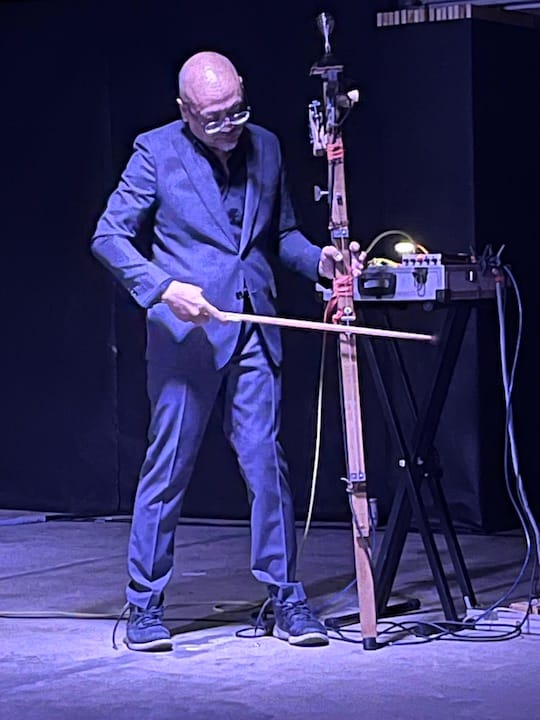
Here, “total” didn’t mean pompous. It meant plumbing the limits of gesture, light, vibration and movement with tools that feel both handmade and half-alive: Dy’s bonefone, a stethoscope-instrument that could make a chiropractor run to the nearest fire exit (literally cracking bone noises in Dy’s right shoulder — quite an achievement in experimental sound creation, if I may say so), the accelerometer McG glove (I wonder if a ’90s Nintendo Power Glove could do the same — a concept I unashamedly could steal for my own gig), Ortiga’s kinetic rigs, and Tad’s tungkod — now in its almost perfect form and sound — with its Godzilla-step “godslam” and that deliciously fascistic “dirty mic” that makes him sound like a rogue radio station broadcasting from martial law.

Miggy Inumerable’s interactive computer graphics stitched the whole thing into a single perceptual membrane — a moving, breathing skin across WHYNoT’s industrial-clean interior. For once, Manila’s humidity worked in our favor; the room felt electrically dense.

TechSabado file photo[/caption]

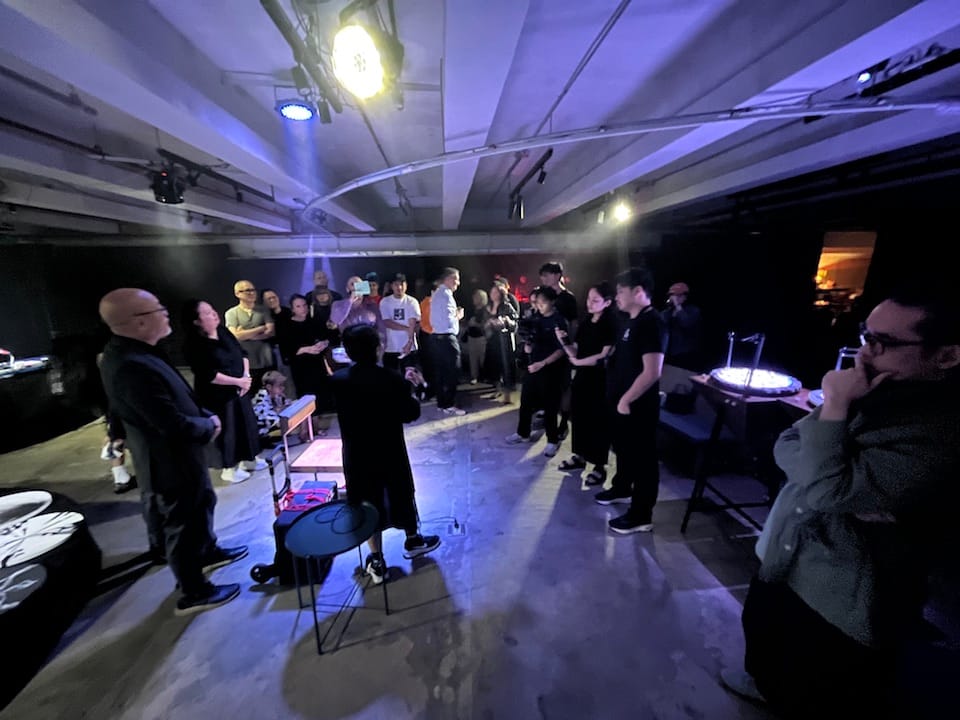
The most interesting part of the night wasn’t even onstage. It was the audience: a younger, mixed expat-plus-Makati set that definitely wasn’t the Cubao X / Intramuros tunnel / on-top-of-postwar-building-in-Escolta or Malate-era sound-art tribe Tad and I came up in. As established installation artist Poklong Anading joked, “Ito ’yung crowd na bumibili ng art.” True. And maybe it’s finally time.

And since Poklong surfaced in the room, I have to shout out fellow sound, and visual artists who hovered around Somatosonic’s experimental turntable like it was an oracle: Lena Cobangbang, Datu Arellano, Corinne de San Jose and Mitch Garcia. We ended up dissecting art, life, and whatever strange frequency Somatosonic had tuned the night into.

Are we, as Marco teased, the pop of sound art? Or something like that. God, I hope not. But maybe it’s good that the scene no longer requires cement floors, broken toilets and cigarette fog to function. Maybe this kind of leveling up just means more bodies encountering the work — even if more than 95% walked in not knowing what sound art actually is.

To me, what mattered was the applause at the end — loud, genuine and a little stunned. Many didn’t know what hit them, but impact doesn’t require literacy. It just requires a nervous system.

There were some minor technical hiccups — that’s a guarantee with custom electronics, sensors and wireless anything. But as any noise artist knows, the beauty of thick electronic texture is that it forgives its creators. The mistakes blur into the thunder. The glitches become part of the vocabulary.

TechSabado file photo[/caption]

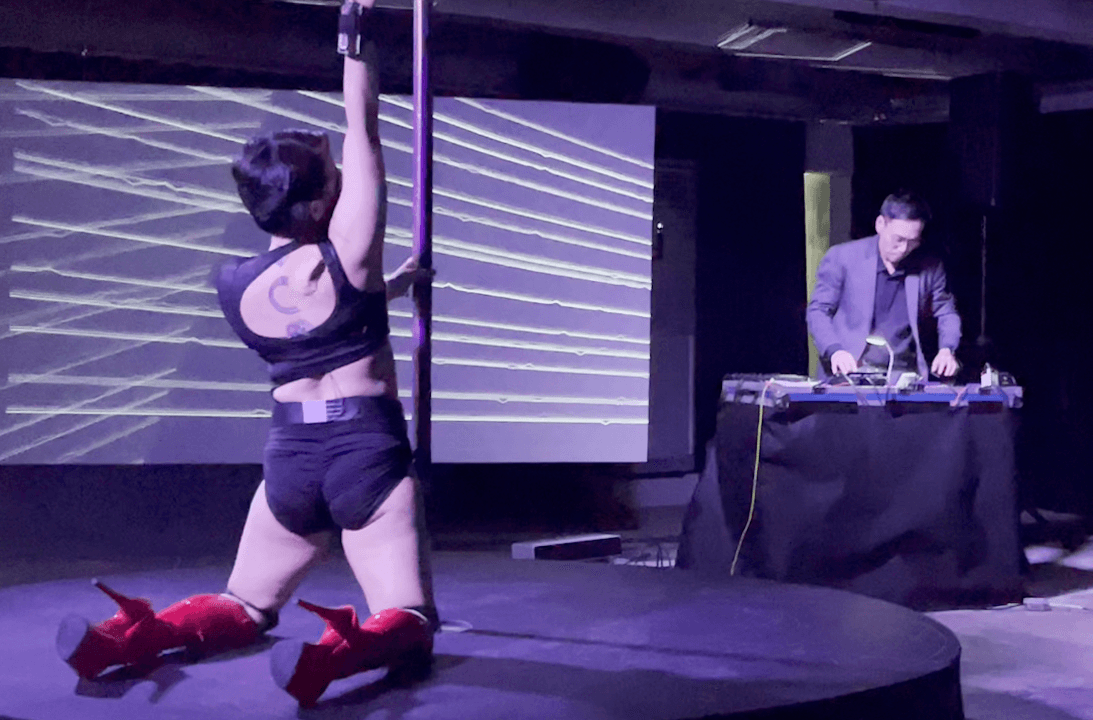
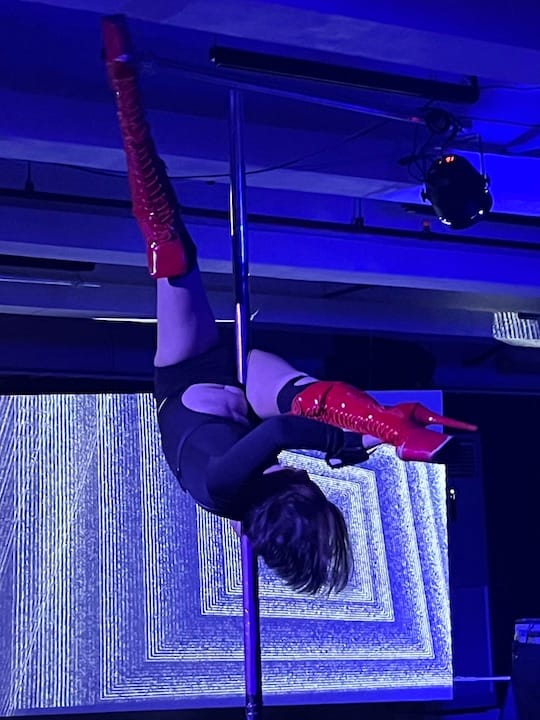
Visual artist CD, meanwhile, delivered one of her strongest forms in recent memory — my memory — not as a “pole dancer,” but, as always, as a sound instrument. Somatosonic’s philosophy of accommodating each other’s ideas shows up clearly in her movements: every gesture is a control message — literally MIDI, metaphorically language — across years of collaboration.

So is this moment good or bad for the scene? Is that even a question? I’ll admit to mixed feelings. Part nostalgia, part relief. Noise, experimental sound, kinetic performance — these were once fringe practices you only found through rumor and stubbornness. Now they’re drawing crowds who arrive with tote bags and leave with Instagram Stories.

TechSabado file photo[/caption]

But watching a roomful of people who had no previous link to experimental sound art sit through 60 minutes of multisensory intensity and walk out buzzing? That’s not dilution. That’s infiltration.

Sound art in Manila is no longer underground. And maybe it doesn’t have to be.

If Totality 1.0 proves anything, it’s that disruption can travel. It can climb four flights of stairs in a Makati art compound. It can surprise the uninitiated. It can make a new generation ask, “What the hell did I just experience?” which, frankly, is the best possible outcome.

Somatosonic didn’t compromise. The audience adapted.

Maybe that’s the real total work of art.

Originally poste on: techsabado.com/2025/11/29/burning-chrome-totality-1-0-when-the-underground-echoes-in-an-upscale-white-cube/

Saturday, March 14, 2026

BURNING CHROME | The internet: From information superhighway to a lonely back road

by Jing Garcia -- because the mind is a terrible thing to taste.

Originally posted on: techsabado.com/2025/11/22/burning-chrome-the-internet-from-information-superhighway-to-a-lonely-back-road/
In the early 1990s, the phrase information superhighway captured the imagination of policymakers, technologists, and journalists alike. It was the rallying cry of an age when dial-up tones and clunky desktops promised a new democratic era of knowledge. Former U.S. Vice President Al Gore became its unofficial salesman, declaring that a highway of information would connect everyone, everywhere. The image was irresistible: fast lanes of ideas, open to all, free of borders, designed to shrink inequality.

Three decades later, the road is still there. But the asphalt has cracked, toll booths have sprouted, cameras monitor every turn, and billboards spew propaganda. What began as a public highway has become a lonely, often hostile back road. And the dream of universal connection has mutated into something more fragmented, more surveilled, and more alienating.

The promise and the paradox

The first great promise was connection. By the mid-2000s, social networks like Friendster, MySpace, then Facebook, claimed they would bring us closer. They did—at least on the surface. A high school crush, an old friend now living in Zamboanga, a former bandmate could suddenly reappear on your screen. For a while, it felt like magic.

But psychologists began to sound alarms. Sherry Turkle of MIT, often called the “Margaret Mead of digital culture,” pointed out that we were trading conversation for connection. In her books and essays, Turkle chronicled how smartphones and social media reduced messy, intimate human interaction into likes, shares, and emojis. We weren’t talking—we were performing. And that performance eroded empathy.

This paradox has only deepened. Pew Research Center’s 2025 survey on teens and mental health reveals that while young people find comfort in online groups, they also feel more anxious, more isolated, and less in control. The American Psychological Association issued similar warnings: Social media is not inherently harmful, but without strong boundaries it magnifies insecurities and worsens sleep, focus, and self-esteem.

In the Philippines, where internet penetration is among the highest in Southeast Asia, the paradox is sharper. Filipino users spend nearly nine hours a day online, much of it on social media. For a people famous for close-knit family ties, it is bitter irony that these networks leave so many feeling alone in a crowd.

Anonymity was supposed to be another great gift of the network. For dissidents under authoritarian regimes, for whistleblowers exposing corruption, for LGBTQ+ youth seeking refuge, it is the digital equivalent of shelter. In 2015, UN Special Rapporteur David Kaye made it clear: Encryption and anonymity are not luxuries, but essential to privacy and free expression.

Civil society groups like the Electronic Frontier Foundation continue to defend this principle. Without anonymity, they argue, dissent is stifled, surveillance becomes unbearable, and freedom shrinks. Ask the activists in Myanmar or Hong Kong, who rely on pseudonyms and encrypted apps to evade persecution.

Yet anonymity cuts both ways. It shields the vulnerable, but it also emboldens the cruel. Trolling, harassment, and mob shaming thrive in the dark corners of anonymous boards and comment sections. As early as the 2000s, Philippine forums like PinoyExchange had their share of flame wars. Today, anonymous Facebook groups and TikTok accounts spread rumor and malice at industrial scale.

The truth is not that anonymity is dangerous, but that ungoverned spaces are. Without moderation, anonymity becomes a license for abuse. With safeguards, it can remain a tool of liberation.

Disinformation as business model

The darker turn of the information highway has been the professionalization of disinformation. It’s no longer just a handful of pranksters pushing hoaxes. It’s an industry.

Oxford University’s Computational Propaganda Project has mapped “cyber troops” across 80 countries—organized groups of state-sponsored or party-affiliated actors using bots, fake accounts, and paid influencers to distort online conversations. In the Philippines, this has become tragically familiar. Keyboard armies have been mobilized for elections, public relations campaigns, even against journalists.

Rappler’s Maria Ressa, who won the Nobel Peace Prize in 2021, documented how Facebook was weaponized in the Philippines. Coordinated networks of fake accounts pushed divisive narratives and smeared critics of those in power. The Cambridge Analytica scandal, which exploded in 2018, traced part of its testing ground to the Philippines—where harvested data was allegedly used to micro-target political ads.

Globally, the Cambridge Analytica affair, revealed by The Guardian, The Observer, and The New York Times, was the smoking gun. Tens of millions of Facebook profiles were mined without consent, building psychological dossiers to manipulate voters. It was proof that surveillance capitalism and political propaganda had merged into one toxic system.

Now, if disinformation was the new business, surveillance became the new infrastructure. Edward Snowden’s leaks in 2013 exposed the vast reach of the U.S. National Security Agency’s PRISM program, which vacuumed data from major tech companies. While those firms disputed details, the disclosures confirmed what many suspected: Mass, suspicionless surveillance had become normalized.

Since then, dozens of governments have imitated or expanded similar programs. Freedom House’s 2024 “Freedom on the Net” report notes that internet freedom has declined globally for 14 consecutive years. Authoritarian regimes deploy spyware, democracies quietly expand monitoring powers, and ordinary citizens live under invisible scrutiny.

Here at home, surveillance also grows quietly. The Philippines passed the SIM Card Registration Act in 2022, mandating registration of mobile numbers with government ID. Officials said it was meant to combat scams and fraud, but critics warned it could enable state surveillance and compromise anonymity. Just this year, civil liberties advocates pointed out data leaks exposing registered users. Meanwhile, the Anti-Terrorism Act of 2020 remains controversial for its vague definitions and surveillance provisions.

When the state can monitor without transparency, and platforms collect data without consent, we are not drivers on the superhighway. We are cargo.

The social disconnection machine

Why does a world of infinite connection feel so disconnected? The answer lies in platform design. Social media companies optimize for engagement, not community. The endless scroll is designed to keep eyes glued, not to build empathy. Notifications are engineered to trigger dopamine, not solidarity.

The results are predictable. Outrage spreads faster than nuance. Envy spreads faster than contentment. Misinformation spreads faster than correction.

Turkle describes this as confusing performance for intimacy. Online, we curate our identities, polish our selfies, stage our meals. We chase likes and call it friendship. We compare ourselves to endless others and call it connection. But the psycho-social effect is more akin to self-surveillance. We become actors on an invisible stage, performing for an audience that is everywhere and nowhere.

In the Philippines, this is amplified by our cultural emphasis on pakikisama and social approval. Facebook isn’t just a platform here—it’s the internet. The hunger for likes merges with cultural pressures to conform. The result is a cycle of hyper-visibility and hidden loneliness.

From a psychoanalytic perspective, the internet amplifies the superego—the internalized voice of judgment. Every selfie posted, every status updated, is subject to immediate scrutiny. The constant gaze of others, even anonymous, drives anxiety and rumination. Instead of binding communities, it fragments them into tribal silos, each echoing its own biases.

Adolescents, still forming their identities, are especially vulnerable. Global studies confirm that while social media can provide belonging, it can also magnify body image issues, depression, and sleep deprivation. For adults, parasocial relationships—with influencers, celebrities, even politicians—replace genuine bonds.

The superhighway, meant to connect, now produces a loneliness epidemic. Studies from the U.S., UK, and Japan warn of rising “social disconnection,” where users report being more alone despite being constantly online. The Philippines is not immune: Psychologists here note increases in reported anxiety and depression, especially during and after the pandemic lockdowns when digital life became the only life.

What then is to be done? The metaphor still serves. We wanted a public superhighway, but we have ended up on privatized toll roads owned by corporations, monitored by states, plastered with propaganda. If we want a truly public road again, we need both rules and redesigns.

First, human rights must be the compass. Protect end-to-end encryption. Defend anonymity. Outlaw mass, suspicionless surveillance. Enact real privacy laws—something the Philippines still lacks in comprehensive form—that punish data hoarding and leaks.

Second, platforms must be forced to redesign. Chronological feeds instead of black-box algorithms. Transparency about political ads. Friction against viral disinformation, such as limits on reshares or fact-check interstitials. Independent audits of algorithmic harms.

Third, civic life must be rebuilt offline. Strengthen schools, libraries, and local forums. Invest in digital literacy that teaches not only how to spot fake news, but how propaganda systems work. Support independent journalism that can follow the money and expose manipulation networks.

Finally, users must demand accountability. We must refuse to be only cargo in someone else’s business model. Connection must be reclaimed as solidarity, not surveillance.

A Pinoy reckoning

The Philippines, once labeled “the social media capital of the world,” is both warning and opportunity. We have seen how digital platforms can sway elections, spread hate, and intimidate journalists. But we have also seen how they can raise money for disaster relief, connect migrant workers to their families, and amplify marginalized voices.

Our task is not to abandon the highway, but to rebuild it. To carve out public lanes where rights are respected, where data is safe, where propaganda is resisted, and where connection means more than curated performance.

The information superhighway was supposed to lead us somewhere better. It still can—but only if we wrestle control back from the corporations and states that have hijacked it. Otherwise, we remain passengers on a lonely, surveilled back road, hurtling toward a future where connection is measured in engagement metrics, not human bonds.

The internet should be the last bastion of freedom. And that bastion must remain free—not only free to connect, but free from tyranny.

Originally posted on: techsabado.com/2025/11/22/burning-chrome-the-internet-from-information-superhighway-to-a-lonely-back-road/

Saturday, March 07, 2026

BURNING CHROME | Cyberpunk: Neon dreams, dark realities

by Jing Garcia -- because the mind is a terrible thing to taste.

Originally posted on: techsabado.com/2025/11/15/burning-chrome-cyberpunk-neon-dreams-dark-realities/

Cyberpunk has always been a prophecy disguised as entertainment. In the 1980s, when William Gibson dropped Neuromancer and Ridley Scott unveiled Blade Runner, the genre declared its manifesto with glowing billboards, synthetic rain, and lonely antiheroes jacked into a network that looked suspiciously like our own internet. Today, the neon has dimmed, but the prophecy lingers. We are left to ask: are we living in a cyberpunk world, or is cyberpunk still the future waiting to happen?

The word "cyberpunk” first appeared in Bruce Bethke’s short story published in 1983 in Amazing Science Fiction Stories. Bethke later admitted he invented the term by smashing together “cybernetics” and “punk” to describe teenage computer rebels. It was editor Gardner Dozois of Isaac Asimov’s Science Fiction Magazine who popularized the label. But it was William Gibson who gave it flesh and blood.

When Gibson released Neuromancer in 1984, he introduced cyberspace, a “consensual hallucination experienced daily by billions.” That phrase became the metaphor we now use to describe the internet itself. Alongside Gibson stood Bruce Sterling, Pat Cadigan, Rudy Rucker, and John Shirley—the so-called Mirrorshades group—who envisioned futures not in the stars, but in urban sprawls, megacorporations, and machines stripping away privacy. Sterling edited the anthology Mirrorshades (1986), often treated as the cyberpunk manifesto.

Gibson, in interviews with Wired magazine during the 1990s, emphasized that he wasn’t predicting the future so much as remixing the present, showing how technology reshapes power. His pessimism resonated with readers who had grown cynical about utopian sci-fi and skeptical of Reagan-era neoliberal promises.

Visions in neon

On film, Ridley Scott’s Blade Runner (1982) crystallized the aesthetic. Based loosely on Philip K. Dick’s novel Do Androids Dream of Electric Sheep?, the film turned Los Angeles into a claustrophobic labyrinth of neon, smoke, and perpetual rain. Syd Mead’s production design remains iconic, while Vangelis’ synth score provided an otherworldly soundscape. Critics like Pauline Kael recognized its visionary mood even when audiences were confused. Today, the film is considered a cornerstone of cyberpunk cinema.

Japan carried cyberpunk further, layering social critique with existential angst. Katsuhiro Otomo’s manga and later animated film Akira (1988) imagined Neo-Tokyo as a city reborn from nuclear ruin, with psychic children and militarized police hinting at authoritarian decay. Mamoru Oshii’s Ghost in the Shell(1995) expanded the genre’s philosophy, asking whether identity can survive when consciousness can be copied into machines. As the New York Times noted in its 1996 review, Ghost in the Shell was “a thinking person’s action movie,” prefiguring debates about AI and posthumanism.

Hollywood absorbed these Japanese visions. The Wachowskis’ Matrix trilogy (1999–2003) openly referenced Ghost in the Shell, Gibson’s Neuromancer, and hacker culture. It popularized terms like “red pill” that have since been co-opted far beyond their original context.

Punk in circuits, sound and words

Cyberpunk is not only visual—it has always been sonic. Vangelis’ work on Blade Runner remains the ur-text of cyberpunk soundscapes: synthetic, melancholic, alien. The industrial music movement of the 1980s, with bands like Front 242 and Skinny Puppy, provided the dystopian rhythms that seemed ripped straight from Gibson’s alleys.

In 1993, Billy Idol recorded a concept album titled Cyberpunk. It was derided by critics but notable for being promoted via early internet fan chats on The WELL, decades before social media became routine. As scholar Karen Collins argued in “Dead Channel Surfing” (2005), industrial music and cyberpunk shared thematic concerns: alienation, surveillance, and machine rhythm as rebellion.

The soundtrack of dystopia was never acoustic; it was always plugged in, distorted, synthesized. Even today, electronic artists like Perturbator and Carpenter Brut borrow heavily from cyberpunk imagery, soundtracking a nostalgia for futures that never quite arrived.

The cruelest twist of cyberpunk is how much of it has come true. Look around: the megacorporations are here, only they’re called Apple, Amazon, Google, Tencent, Meta. Their empires stretch across the globe, powered by our data and attention.

Shoshana Zuboff, in her 2019 book The Age of Surveillance Capitalism, argued that corporations now harvest behavioral data to predict and influence our choices. That could have been a Gibson plotline. Instead, it is our reality.

Gig workers on motorbikes wait for food delivery pings in the rain. AI writes news, creates art, and filters resumes. Hackers wage digital wars while governments install spyware into phones, as documented by Citizen Lab’s reports on Pegasus spyware. The “high tech, low life” slogan once used to describe fiction now describes Manila traffic under the glare of LED billboards, while your e-wallet bleeds hidden fees.

A critique wearing cool shades

But cyberpunk was never just about gadgets. It was social criticism wrapped in neon. It asked what happens when deregulation and privatization leave citizens powerless before giant systems. It interrogated identity, race, gender, and class—though often imperfectly.

Feminist scholar Donna Haraway’s A Cyborg Manifesto(1985) gave the movement a theoretical lens. Haraway argued that the boundaries between human, animal, and machine were dissolving, and that embracing hybridity could challenge patriarchal systems. This remains one of the most cited texts in science and technology studies, intersecting with cyberpunk’s visions of blurred identities.

The genre’s contradictions persist. It romanticizes the rebel hacker but warns that rebellion may be futile. It fetishizes neon cityscapes even as it critiques them. As Fredric Jameson once warned, late capitalism tends to commodify even its critiques, turning rebellion into wallpaper. Cyberpunk’s imagery is now used to sell smartphones and luxury fashion, stripped of its subversive edge.

Curiously, cyberpunk endures because it speaks to the unease of digital living. The internet is not the utopian commons once promised—it is a corporate maze, gamified and surveilled. Cyberpunk predicted the masks we wear online, the blurred line between avatar and self, and the illusion of freedom in walled gardens.

Gamers explore these anxieties in role-playing worlds like R. Talsorian’s Cyberpunk 2020, FASA’s Shadowrun, and CD Projekt Red’s troubled but ambitious video game Cyberpunk 2077. Each retells the same fable: technology liberates but also enslaves. We crave implants, connectivity, and digital escape, even as we fear the loss of autonomy.

Punk as prophecy living the neon nightmare

The irony is that cyberpunk was once considered niche, even disreputable. Today, it is mainstream. Its visuals dominate video games, anime, advertising, and streaming platforms. Its language shapes how we discuss AI, virtual reality, and biohacking. But to embrace only the style without the politics is to miss the point.

Cyberpunk’s agenda was always to expose power. Its antiheroes are not space explorers but street-level survivors navigating systems too big to fight. The lesson is clear: don’t worship the neon skyline—interrogate the system behind it.

So, are we living in cyberpunk times? The answer is yes—and no. The corporations, surveillance, and AI are real. The dystopia is creeping. But unlike the characters in Gibson’s Sprawl, we still have agency. Governments can regulate. Citizens can resist. Communities can reclaim technology for collective good. The future is not yet written, and that is the real punk spirit.

Cyberpunk is popular not because it glamorizes despair, but because it helps us see the machinery of control. It gives us a language of resistance. It reminds us that technology is never neutral, that every neon light casts a shadow.

The genre’s enduring question remains ours: will we let the future be built without us, or will we hack back the system before it consumes us entirely?

Originally posted on: techsabado.com/2025/11/15/burning-chrome-cyberpunk-neon-dreams-dark-realities/